Content Service Providers: Why Hybrid Content Is the Future of Inflight Entertainment
Hybrid content is becoming the default inflight model in 2026: licensed caching for reliability, edge refresh for freshness, and selective streaming where rights and QoS allow. This article explains why content service providers are central to making it work.

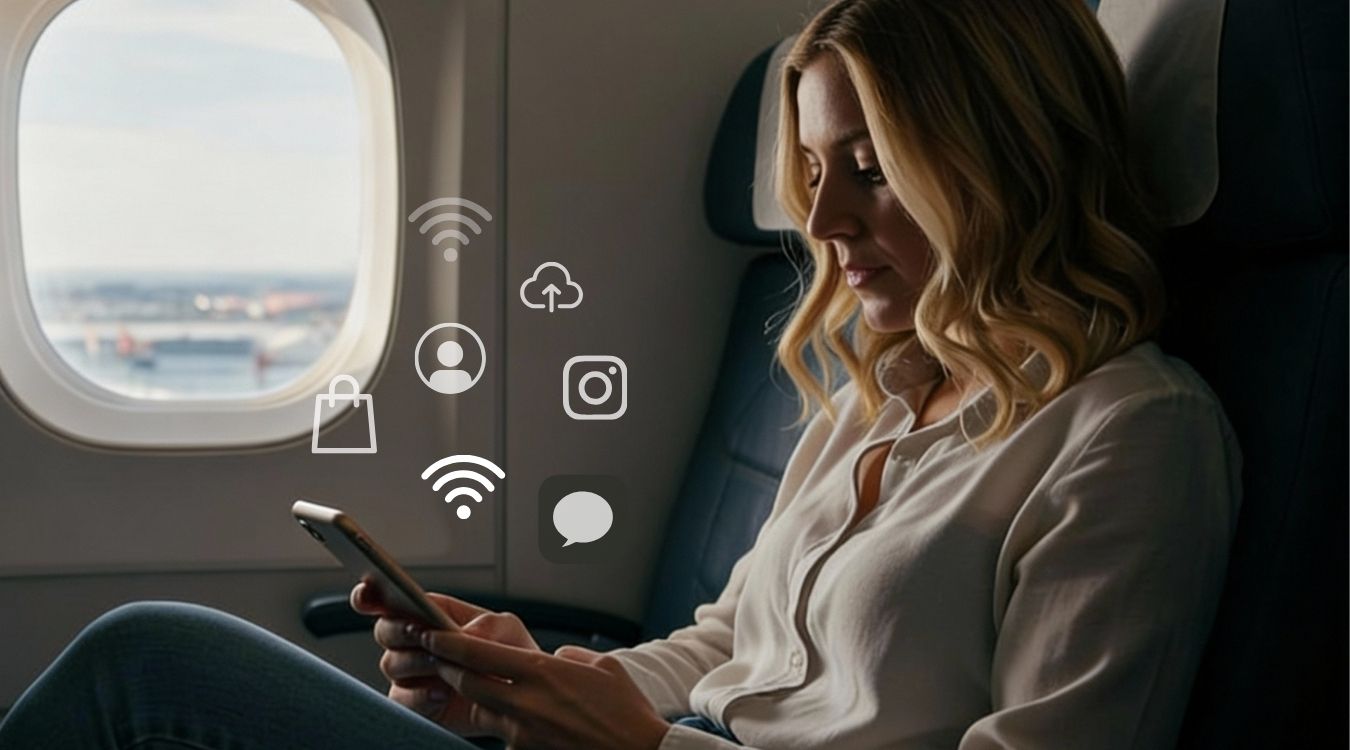
Airline passengers now board expecting a home-like digital experience, with seamless access to their everyday apps and content. As LEO connectivity scales, that expectation is getting louder and it’s tempting for airlines to believe the answer is 100% internet streaming.
However, greater bandwidth does not eliminate rights issues or solve reliability problems. It challenges the passenger experience and gives content service providers (CSPs) a more important role: it is no longer just a matter of providing a “content library,” but of establishing a connected entertainment ecosystem that can operate globally, legally, and profitably.
In 2026, the winning model is clear: hybrid content (licensed caching + edge refresh + selective streaming).
What is a Content Service Provider?
In the aviation industry, the content service provider (CSP) is the partner that provides airlines with licensed and updated inflight entertainment content.
Historically, CSP value was obvious: curated catalogs, predictable licensing, and operational delivery.
In 2026, CSP value expands:
“LEO bandwidth will kill onboard content”
LEO changes bandwidth economics. But the “stream everything” idea collapses the moment you experience real-world constraints:
- Licensing is territorial (aircraft move across territories)
- OTT services don’t grant inflight rights by default
- Unlimited streaming destroys experience control (you lose engagement, cross-sell, and brand touch points)
Why OTT licensing breaks at 35,000 feet?
Most passengers have already seen how territorial licensing works: try watching a specific show on Netflix while traveling abroad and you’ll often find a different catalog, or the title simply unavailable due to geo-restrictions. That’s normal in consumer streaming. Inflight is worse.
No major streaming service “permits inflight” under standard consumer terms
General streaming terms do not equal inflight rights. The Runway Girl Network coverage quotes the point directly: “no major streaming service explicitly permits inflight access under standard terms and conditions,” and inflight licensing happens via airline and content owner agreements not consumer OTT terms.
Rights are licensed by territory, not for an aircraft in motion
Rights are licensed by territory and time windows, not for an aircraft that’s constantly moving across jurisdictions. That’s why the “just let passengers log into their own streaming accounts” idea sounds simple, but collapses in real operations.
At APEX/FTE Asia Expo 2025, the panel made this explicit: full integration of personal streaming accounts remains complex because content rights are sold by territory, while the aircraft is literally crossing borders. In practice, the same passenger could move through multiple legal/licensing contexts during a single flight and the airline still has to prove that content access and distribution remains compliant at every step.
Beyond “content lists” : what CSPs actually provide in 2026?
Content is becoming an ecosystem, not a static library, with full-service carriers looking to engage passengers.
Rights aggregation at scale
CSPs reduce complexity by aggregating and negotiating distribution rights across territories, windows, and platforms, so airlines don’t have to negotiate title-by-title with every studio and rights holder. This is meticulous, contract-heavy work (usage rights, geographies, formats, durations, reporting) and it’s exactly what makes scalable, multi-region catalogs possible without exposing the airline to constant compliance risk.
Metadata, localisation, and safety edits
Multilingual catalogs and airline-brand fit. CSPs operationalise metadata, subtitles/dubs, cultural suitability, and regulatory constraints so content can scale.
Update pipelines powered by connectivity
Connectivity enables more frequent refresh but only if your content pipeline can ingest, validate, and distribute updates consistently (and without breaking the onboard experience). The industry discussion explicitly points toward modern IPTV, FAST channels, and edge-cached content as practical paths while licensing catches
CSP helps keeping passengers engaged with the airline
Safran Passenger Innovations’ Ben Asmar frames the problem sharply: if passengers are “lost to the internet,” opportunities for future engagement get harder, hence the move to “connected IFE platforms” where the “E” stands for engagement

“Content is not a catalog. It’s a strategic layer that enables personalisation, reinforces the airline’s brand image, and drives loyalty by keeping the passenger experience consistent and engaging throughout the journey.”
The winning architecture: Hybrid delivery (licensed + edge + selective streaming)
Core licensed catalog (cached onboard)
This is the baseline: a licensed catalog physically stored on the aircraft (server/box) and delivered over the onboard Wi-Fi network, without depending on the satellite link. Technically, the playback path stays local (passenger device to cabin Wi-Fi network to the onboard content server) which is why the experience is predictable. From a rights standpoint, caching also gives you control. You know exactly what titles are onboard, under which inflight licenses, and you can enforce access rules inside a closed distribution environment (encryption at rest, DRM/forensic watermarking when required, controlled publishing cycles). In short, cached content is the reliability and compliance backbone.
Edge-cached freshness (synced via IFC/LEO when available)
Edge caching provides “streaming-like” immediacy. The aircraft behaves like an edge node: it periodically refreshes its onboard cache when connectivity is available and stable, then continues to serve content locally. The technical advantage is that you can update what matters (new episodes, subtitles) as incremental packages rather than re-downloading entire libraries, and you can schedule those updates around bandwidth constraints (onboard connectivity, ground time, off-peak, good link conditions). If the link degrades mid-flight, playback doesn’t collapse, because passengers are still consuming content from the local cache.
In 2026, inflight content is shifting to an edge-first model: cloud-managed, locally delivered, and selectively refreshed via connectivity. Passengers want their content. Studios want rights respected. Airlines want engagement and brand control.

Descubra nuestras últimas noticias




.webp)



%20(6).png)
%20(1).png)
%20(3).png)
%20(6).png)
%20(9).png)
.png)








¿Listo para redefinir su camino con soluciones innovadoras?
Impulse su transformación digital con Moment