
Inflight Ancillary Revenue Guide: How Airlines Generate Revenue Beyond the Ticket
This guide covers the full spectrum of inflight ancillary revenue levers: onboard retail, connectivity monetisation, advertising, pre-order and personalisation. Built for airline and IFE teams looking to increase per-passenger yield with a structured, deployable approach.

Key findings
- Ancillary revenues represent 14.5% of total global airline revenue in 2025 — approximately $145 billion. The gap between top and bottom performers on ancillary yield per passenger exceeds the gap on ticket revenue. (IATA, December 2024)
- Average passenger ancillary spend: $90 per flight in 2024, projected to reach $120 by 2030. The gap is not a demand problem — passengers are willing to spend more. It is a platform and payment accessibility problem. (Valour Consultancy)
- 19% of passengers cite payment friction as a direct barrier to ancillary purchases. Digital wallets represent 50% of global e-commerce payments but remain underdeployed onboard. (IATA Global Passenger Survey 2024)
- 42% of passengers accept advertising in exchange for free Wi-Fi. Advertising-funded connectivity recovers infrastructure costs while maximizing adoption — which drives platform engagement and retail conversion. (Moment Ancillary Revenue Guide)
- Destination services — hotel bookings, transfers, city passes, event tickets — generate higher margins than physical duty-free. Operators anchored to trolley-era product mixes are systematically undermonetizing their passenger relationships. (Moment Ancillary Revenue Guide)
The aviation industry is crossing a historic threshold. Total passenger and freight revenues are projected to reach $1.007 trillion in 2025, up 4.4% from 2024. Within that figure, ancillary revenues account for $145 billion, 14.5% of total industry revenue.
The gap between airlines that capture this revenue and those that don’t is widening. In 2023, United Airlines generated $9.53 billion in ancillary revenue. Delta Air Lines followed with $9.36 billion. These numbers dwarf what most carriers achieve, and they come from the same passengers, on the same flights.
The difference is execution: payment infrastructure, product range, personalization, and the platform that connects them onboard.

Why inflight retail is growing faster than ticket revenue
The inflight retail market was valued at $3.5 billion in 2024. It is projected to reach $5 billion by 2030, a 42% increase. Average onboard spend per passenger is expected to grow from $90 to $120 over the same period, a 30% uplift.
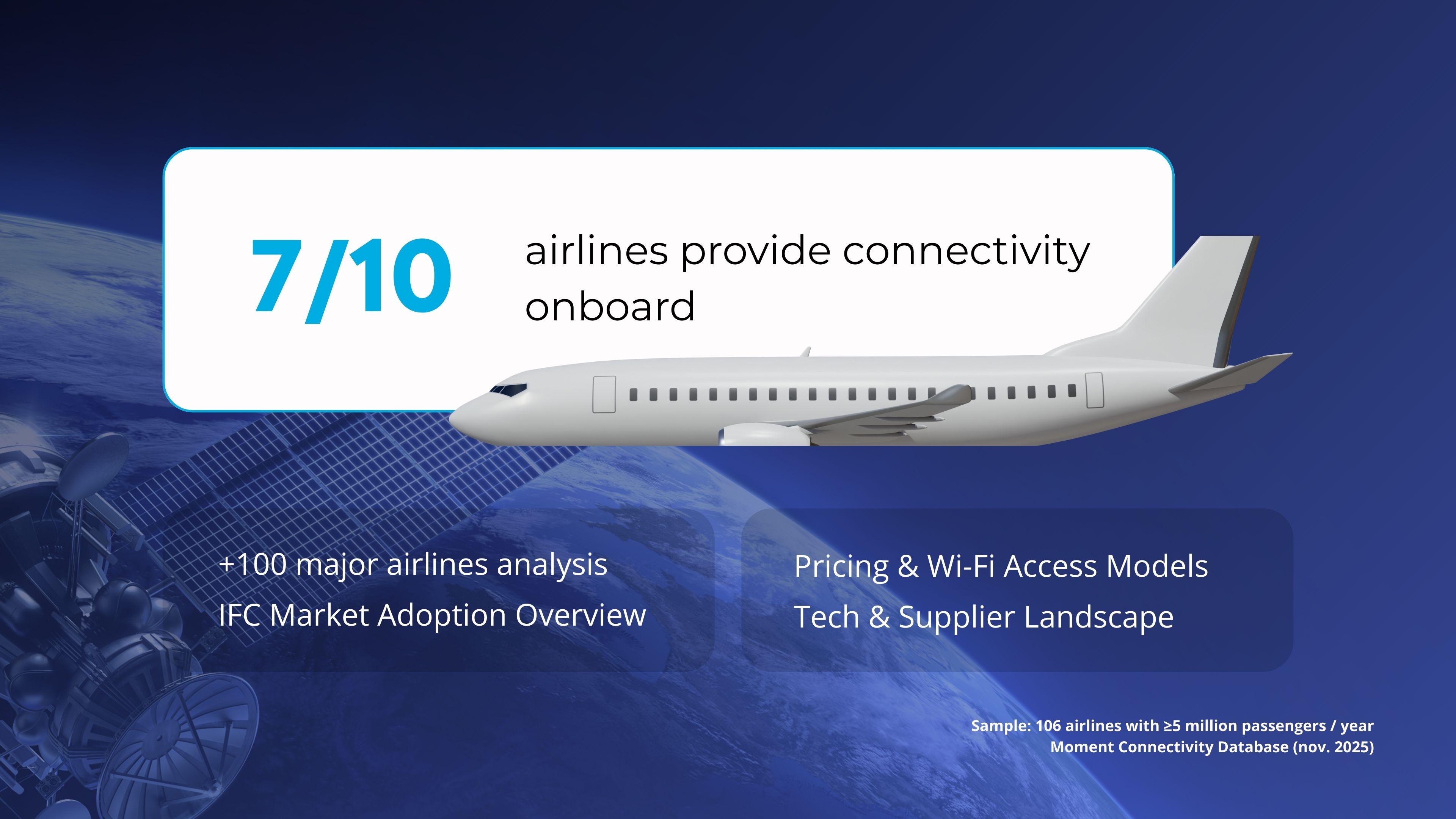
This growth is not passive. It reflects a structural shift in how airlines think about the cabin. Connectivity is the enabling layer: 22% of passengers now consider onboard connectivity as critical as ticket price when choosing an airline. With one-third of commercial aircraft connected in 2024 and half projected by 2030, the addressable market for buy on board services is expanding at fleet level.
The question is no longer whether passengers will spend onboard. It is whether airlines have the infrastructure to convert that intent.

3 ways airlines are growing ancillary revenue
1. Payment infrastructure
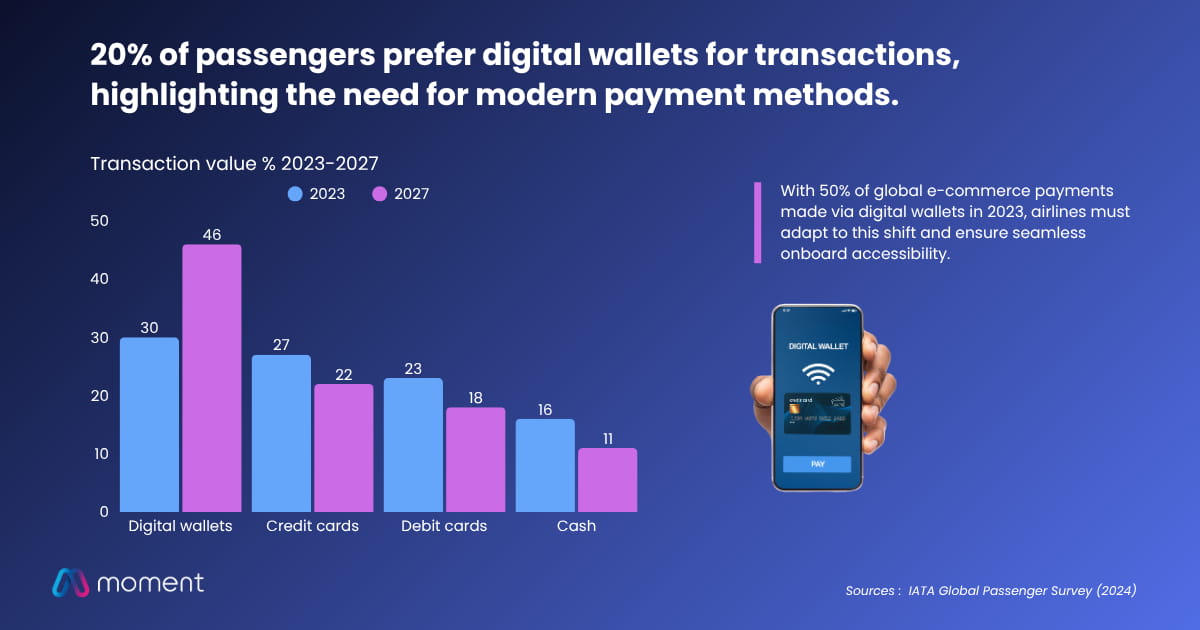
19% of passengers cite payment friction as a direct barrier to ancillary purchases. 20% prefer digital wallets. In 2023, digital wallets already accounted for 30% of global e-commerce transaction value, projected to reach 46% by 2027. Airlines operating cash-only or card-only payment systems are structurally leaving revenue on the table.
The fix is architectural: enable digital wallets, loyalty point redemption, and multi-option payment at the point of purchase, whether that’s a seat-back screen, a passenger device, or a crew tablet.
2. Product and service range
Low-cost carriers built ancillary revenue on a narrow base: seat selection, extra baggage, travel insurance. That model is reaching its ceiling. The airlines growing ancillary revenue fastest are expanding into four categories: physical products (duty-free, airline merch, electronics, spirits), airline services (class upgrades, lounge access, Wi-Fi), airport services (parking, transfers, car rental), and destination services (hotel reservations, museum tickets, city passes, event tickets).
Top-selling inflight product categories today: airline merchandise, electronics, spirits. These three alone signal how far the category has moved from traditional duty-free.
3. Shopping experience
A well-structured onboard retail platform drives conversion through three mechanisms: personalization (offers tailored to travel history and passenger profile), delivery flexibility (in-seat delivery and home shipping for bulky items), and ground-to-air continuity (a single marketplace accessible pre-flight, onboard, and post-flight).
Passengers spend more when the experience is frictionless. The platform architecture determines whether an airline captures that intent or loses it to friction.
Inflight advertising: a growing revenue stream
47% of passengers would be less likely to connect to onboard Wi-Fi if they had to pay for it. 42% are willing to see ads in exchange for free access. That trade-off is the foundation of the advertising-funded connectivity model, and it is scaling.
The global inflight advertising market was valued at $0.4 billion in 2023. It is projected to reach $0.68 billion by 2032 (Business Research Insights). Display systems account for 60% of market share, inflight magazines 20%, apps 12%.
For airlines operating a Wi-Fi portal with advertising inventory, connectivity becomes a self-funding asset. The ISP cost is offset by advertising revenue, and the free access model drives higher passenger engagement, which in turn increases retail conversion.
Inflight entertainment monetisation
71% of passengers rate access to personalized streaming content as particularly important. Streaming, VOD, games and press can be monetised through three models: pay-per-view, subscription passes, or freemium (basic content free, premium releases paid).
The bandwidth constraint is real. High-definition streaming consumes significant satellite capacity. The operational answer is a hybrid IFE platform that serves cached local content for standard viewing and reserves satellite bandwidth for premium purchases and connectivity, keeping costs controlled while preserving the passenger experience.
The rail sector is ahead of aviation on content monetisation models. The full guide covers how leading European rail operators have structured freemium and tiered access, and what airlines can take from that playbook.
Airline ancillary revenue trends: what the data tells IFE and revenue teams
Ancillary revenue at scale is not a product decision. It is a platform decision.
Airlines generating $9B+ in ancillary revenue operate unified digital ecosystems: one marketplace across all touchpoints, tiered access models aligned to loyalty, payment infrastructure that meets passengers where they are, and advertising inventory that offsets connectivity costs.
The gap between a carrier generating $50 per passenger in ancillary revenue and one generating $120 is almost never the product catalogue. It is the infrastructure that presents, processes and delivers that catalogue onboard.
The full guide covers the 6 operational levers to maximise ancillary revenue, from payment architecture to advertising strategy and content monetisation, with airline-specific examples across aviation and rail. Used by IFE managers, ancillary revenue leads and digital teams at airlines and IFEC vendors to structure their onboard revenue strategy. Free download.
Frequently asked questions
How do airlines increase ancillary revenue per passenger?
The highest-impact sequence is: fix payment (add digital wallets, remove checkout friction), then personalize (use passenger data to serve relevant offers at the right moment), then expand the product mix beyond duty-free into destination services and connectivity upgrades. Airlines that address payment friction first see the fastest revenue lift because they are capturing demand that already exists but is currently abandoned at checkout. Personalization multiplies the effect by increasing offer relevance — which raises both conversion rate and average basket size.
What are the most effective inflight ancillary revenue strategies in 2025?
Three levers consistently outperform: advertising-funded connectivity (42% of passengers accept ads for free Wi-Fi, which maximizes adoption and platform dwell time), destination services (highest margin category and fastest growing), and loyalty-integrated pricing (freemium tiers that reward frequent travelers with connectivity and content upgrades while capturing data). Airlines that treat these as separate programs underperform airlines that run them as a single integrated commercial architecture from the portal layer down.
How does digital buy-on-board compare to traditional trolley service for airline revenue?
Digital ordering removes three structural constraints of the trolley model: the fixed purchase window (trolley passes once; the app is available for the full flight), the inventory visibility problem (passengers can see what is available rather than what the crew is pushing), and the payment friction of physical transactions. The result is a wider purchase window, higher average basket size, and real-time inventory data that informs the next flight’s stock. Operators who have made this transition report per-flight F&B and retail revenue uplift that exceeds platform operating costs.
Which inflight ancillary categories generate the highest revenue per passenger?
Among services: seat upgrades, Wi-Fi access, and lounge passes generate the highest per-unit margin. Among physical products: spirits, electronics, and airline merchandise consistently lead. Destination services — hotel reservations, transfers, city passes, event tickets — are now the fastest-growing category and highest-margin per transaction. For low-cost carriers, the top three remain seat selection, extra baggage, and travel insurance — but the margin gap between these legacy categories and destination services is narrowing rapidly as onboard digital platforms mature.
Discover our latest reports






Ready to redefine your journey with innovative solutions?
Start powering your digital journey with Moment.