
Global Inflight Connectivity Benchmark 2025: Access Models, Pricing and Adoption Across 100+ Airlines
Built from the Moment Connectivity Database, this benchmark covers more than 100 airlines worldwide. It maps access models, pricing structures, ISP partnerships and fleet adoption rates to give airline teams a structured reference for their own IFC strategy.
Key findings
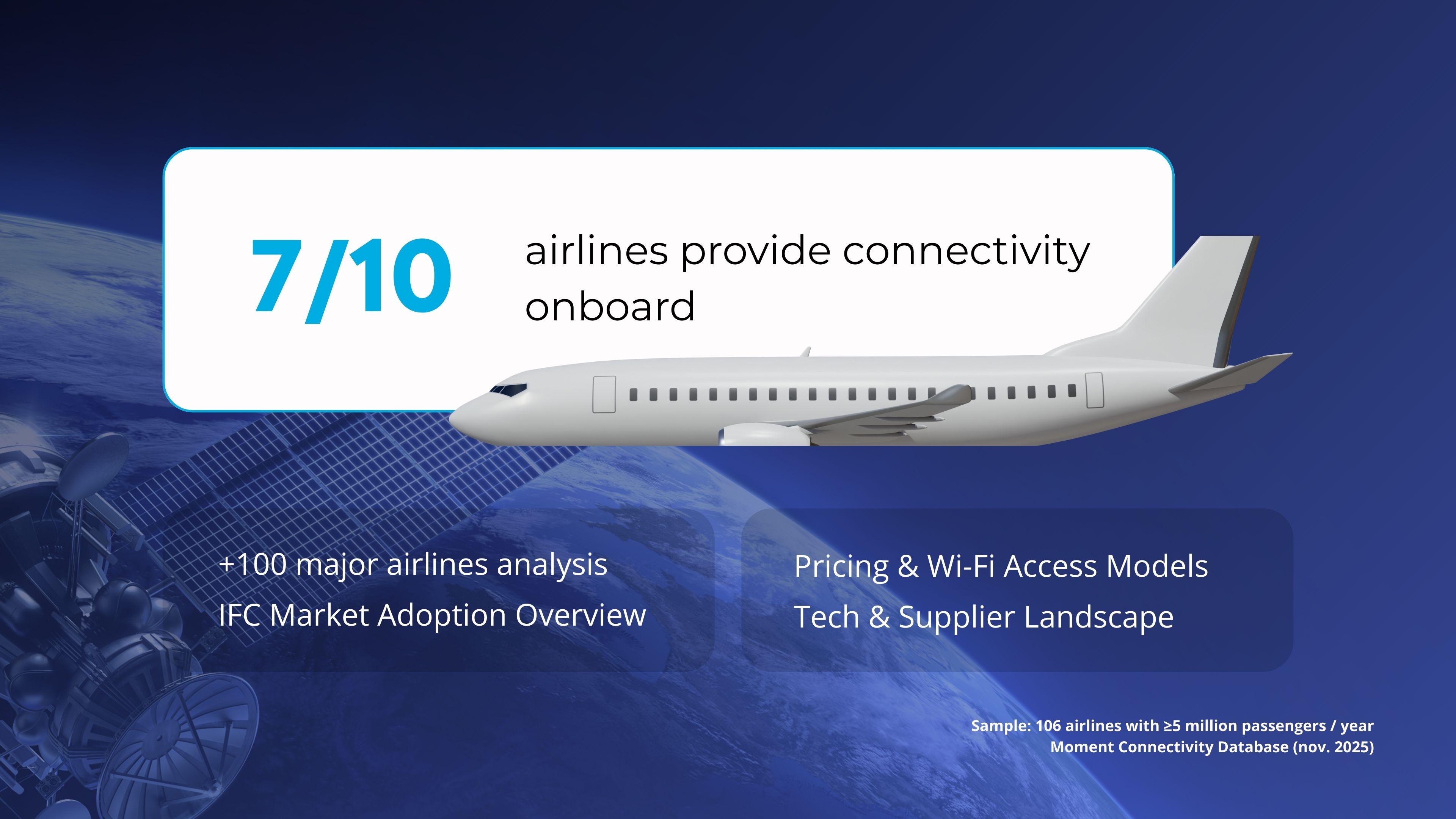
- 7 in 10 airlines provide inflight connectivity in 2025. Legacy carriers: 89% fleet adoption. Budget carriers: 43% globally. The Americas is the only region where budget airlines meaningfully close the gap, at 71%. (Moment Connectivity Database, 106 airlines, Nov. 2025)
- Freemium is the global standard at 58% of connected airlines. Fully free Wi-Fi remains rare at 13%. The growth vector is loyalty-gated free access — simultaneously growing the loyalty database and NPS. (Moment Connectivity Database, Nov. 2025)
- Global average connectivity prices: $3.73 for messaging, $9.99/hour, $19.70 for a full-flight pass. Operators pricing outside these benchmarks without a clear rationale are either leaving revenue on the table or suppressing adoption. (Moment Connectivity Database, Nov. 2025)
- Europe leads legacy carrier connectivity at 98% adoption, but only 8% of European airlines offer fully free Wi-Fi. LEO cost reductions are making free-access models viable for a wider set of operators. (Moment Connectivity Database, Nov. 2025)
- The differentiator between median and best-in-class IFC programs is not the ISP — it is control over access rules, pricing, and passenger data. Two airlines on the same ISP can deliver radically different commercial outcomes. (Moment IFC Benchmark 2025)
This inflight connectivity benchmark maps the global airline connectivity market across 106 airlines in 4 regions — Europe, Asia-Pacific, the Americas and Middle East & Africa. Built from the Moment Connectivity Database (November 2025), it maps IFC adoption rates, Wi-Fi access models and pricing strategies across legacy and budget carriers worldwide. The panel includes 72 legacy carriers, 28 budget airlines, 3 leisure and 3 regional carriers.
Inflight connectivity adoption: 7 in 10 airlines now offer onboard Wi-Fi
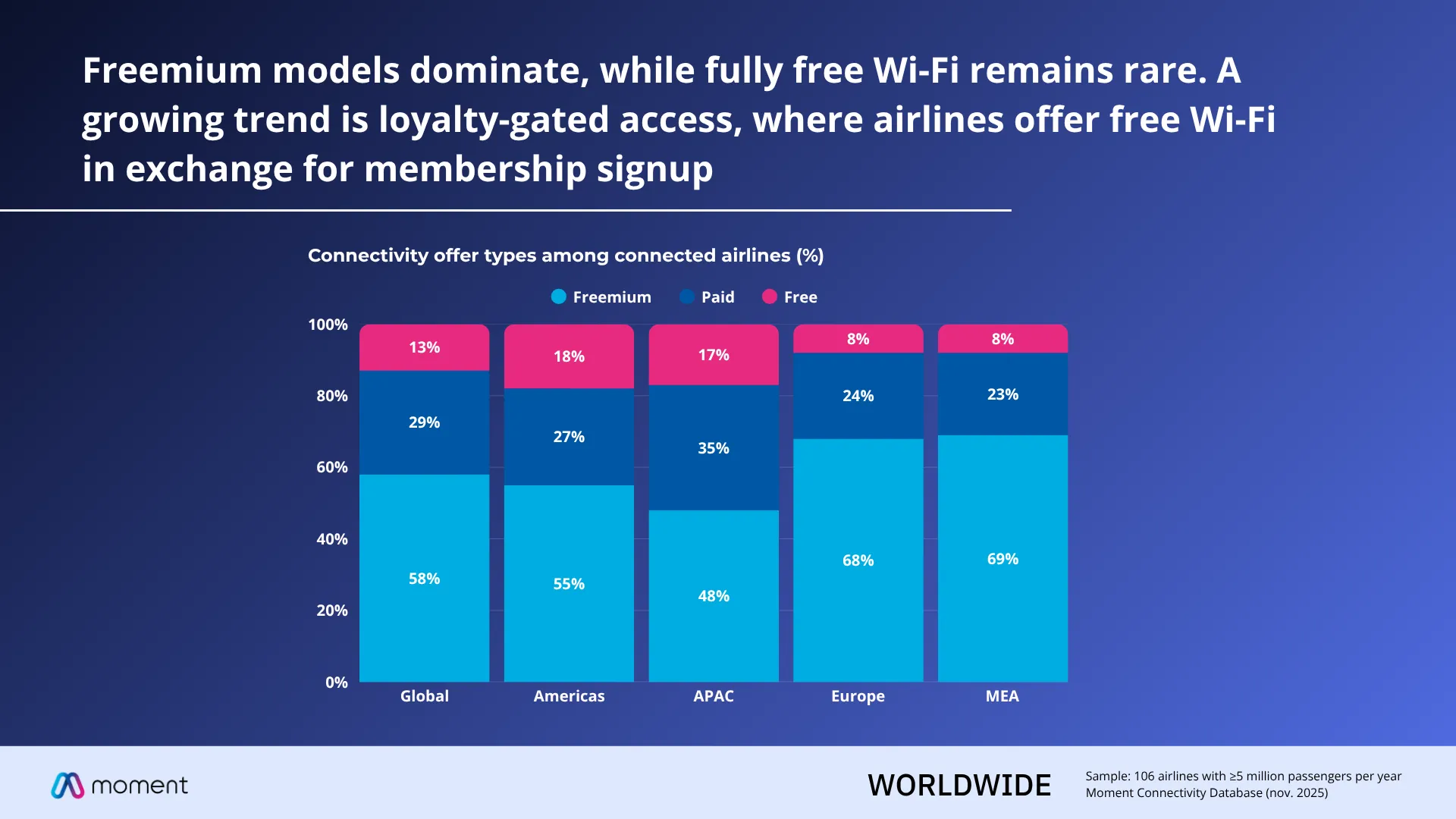
Legacy carriers are setting the pace. 89% of legacy fleets are partially or fully connected globally, according to the Moment Connectivity Database (November 2025). Budget carriers are catching up, but unevenly.
The gap between carrier types varies significantly by region:
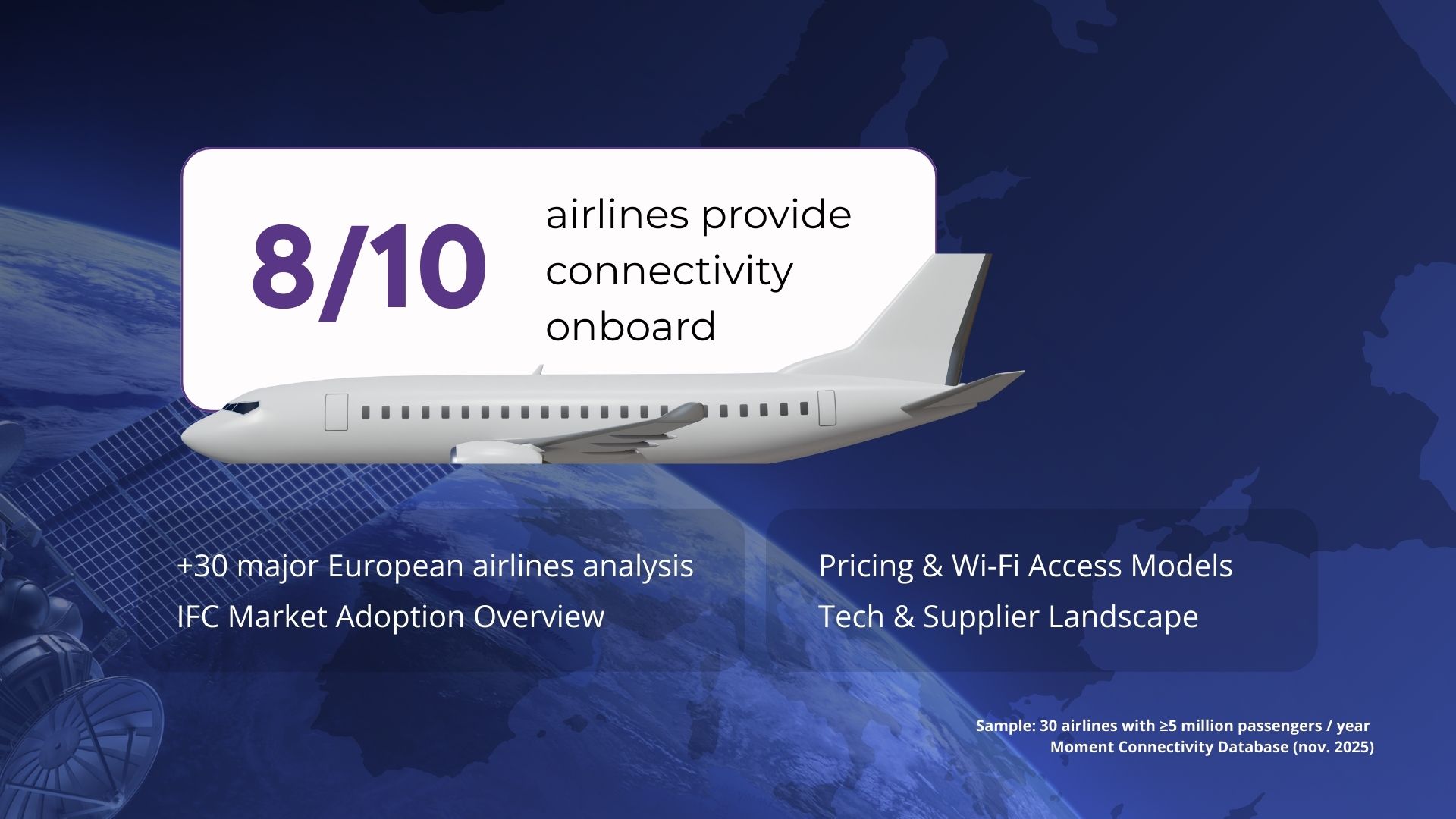
- Europe: Legacy 98% / Budget 43%
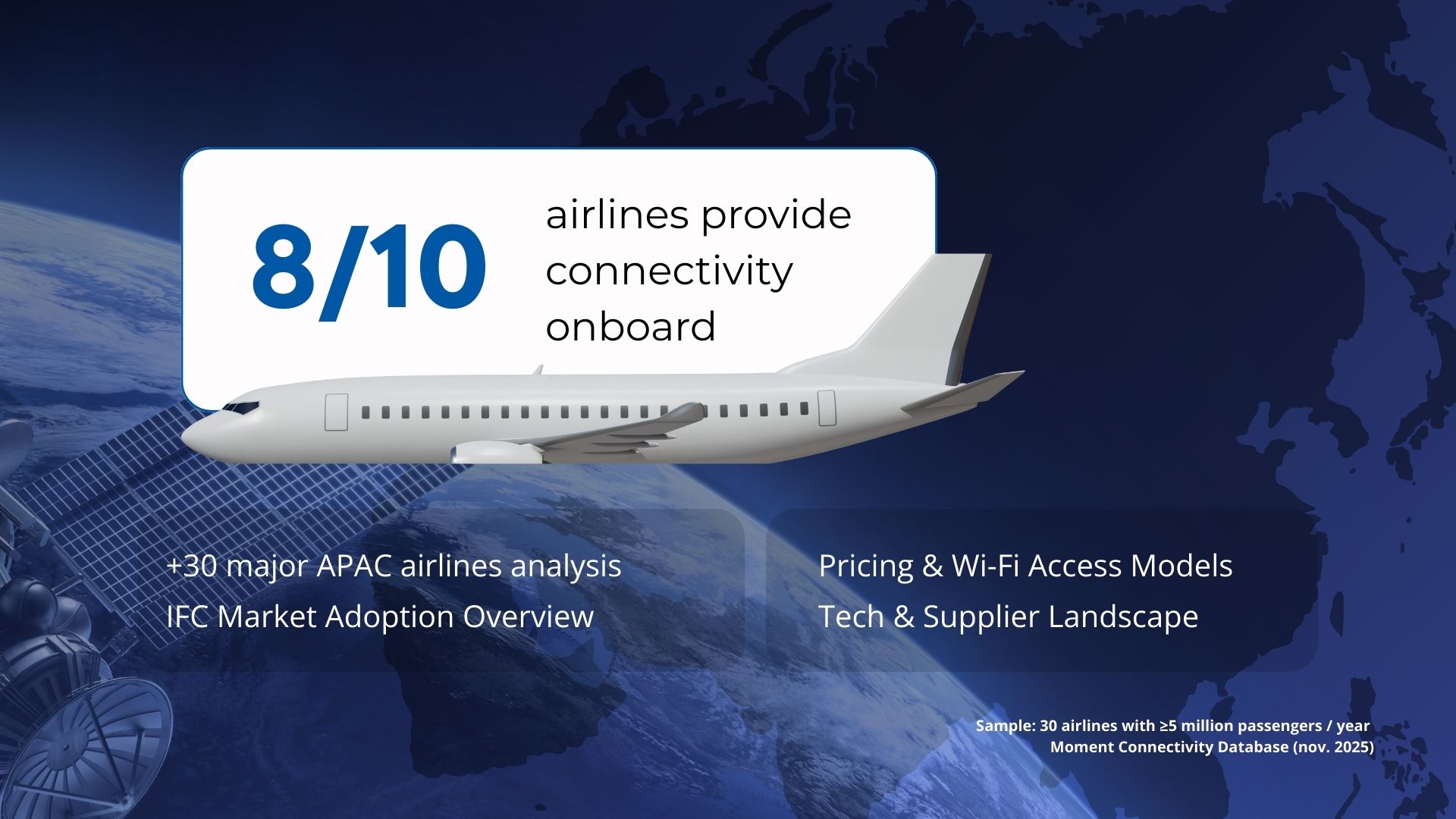
- Asia-Pacific: Legacy 95% / Budget 33%
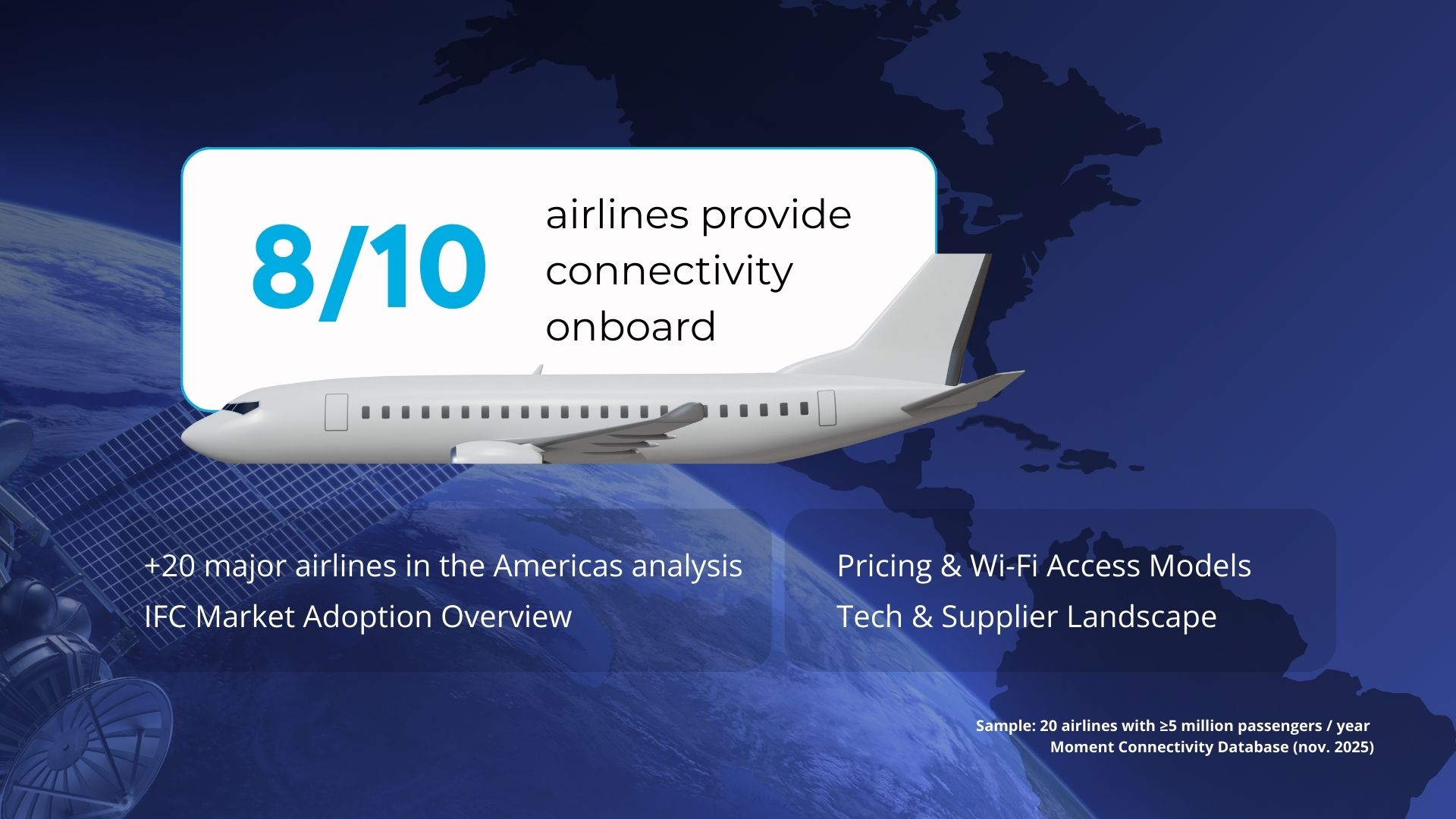
- Americas: Legacy 92% / Budget 71%
- Middle East & Africa: Legacy 67% / Budget 20%
The Americas stands apart. It is the only region where budget carriers offer free Wi-Fi: 14% of LCCs have already moved in that direction. MEA remains in early consolidation: only 1 in 2 airlines in the panel is equipped.
Airline Wi-Fi access models: why freemium has become the global standard
58% of connected airlines have adopted a freemium model. A freemium inflight connectivity model provides passengers with complimentary basic access, typically messaging, while charging for full browsing or streaming. Paid-only models account for 29%. Fully free Wi-Fi: 13%.
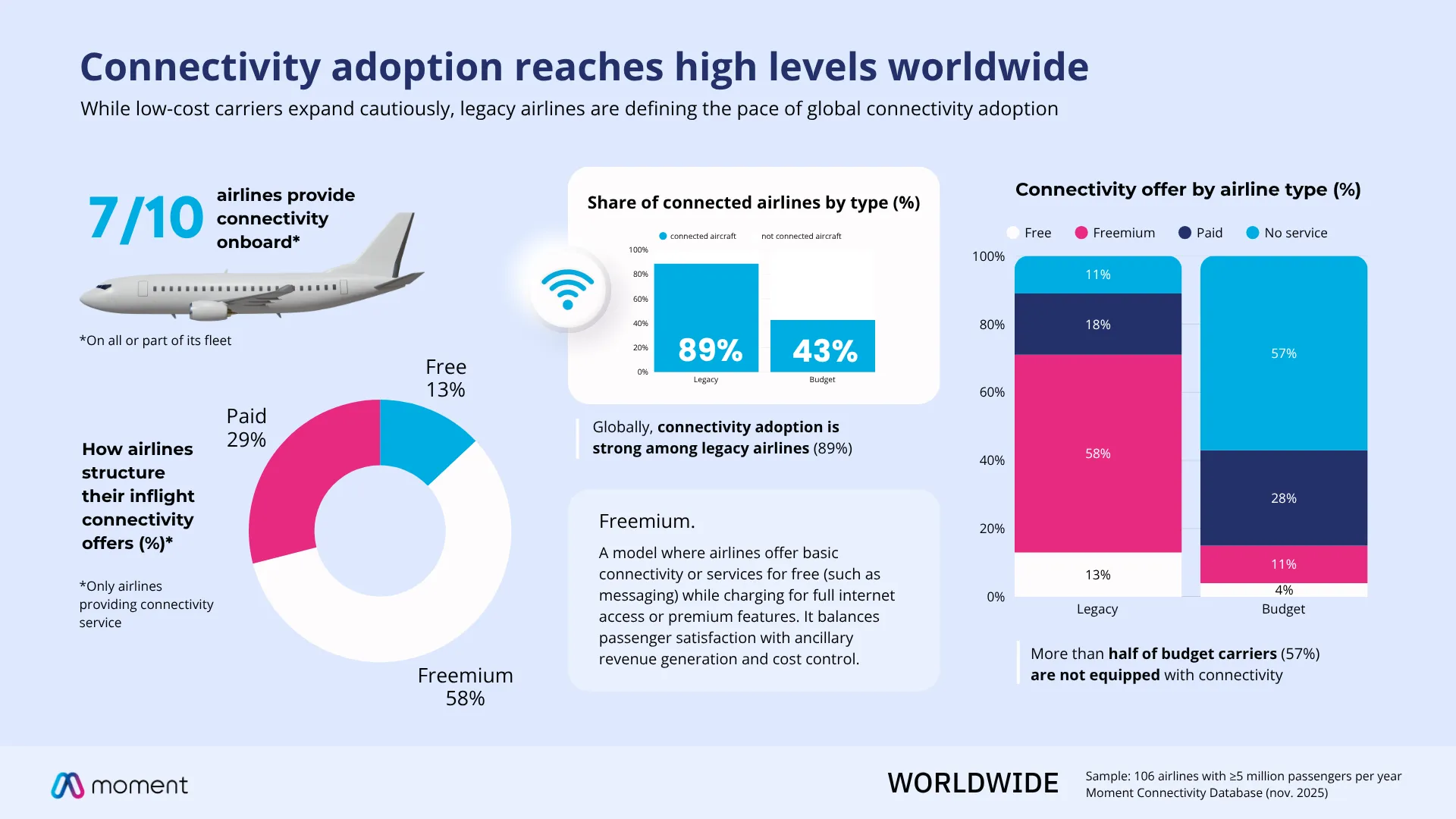
Europe and MEA are the most freemium-heavy markets, at 68% and 69%. APAC has the highest share of paid-only models (35%) but is moving fast: 19% of legacy airlines there now offer fully free Wi-Fi, well above the 13% global average.
Loyalty-gated free access is the clearest shift in the data. Airlines offer complimentary Wi-Fi in exchange for frequent flyer signup, converting connectivity into a CRM acquisition tool. A well-configured Wi-Fi portal is what makes that model operationally viable at scale.
Inflight Wi-Fi pricing models: duration, usage and the rise of subscription passes
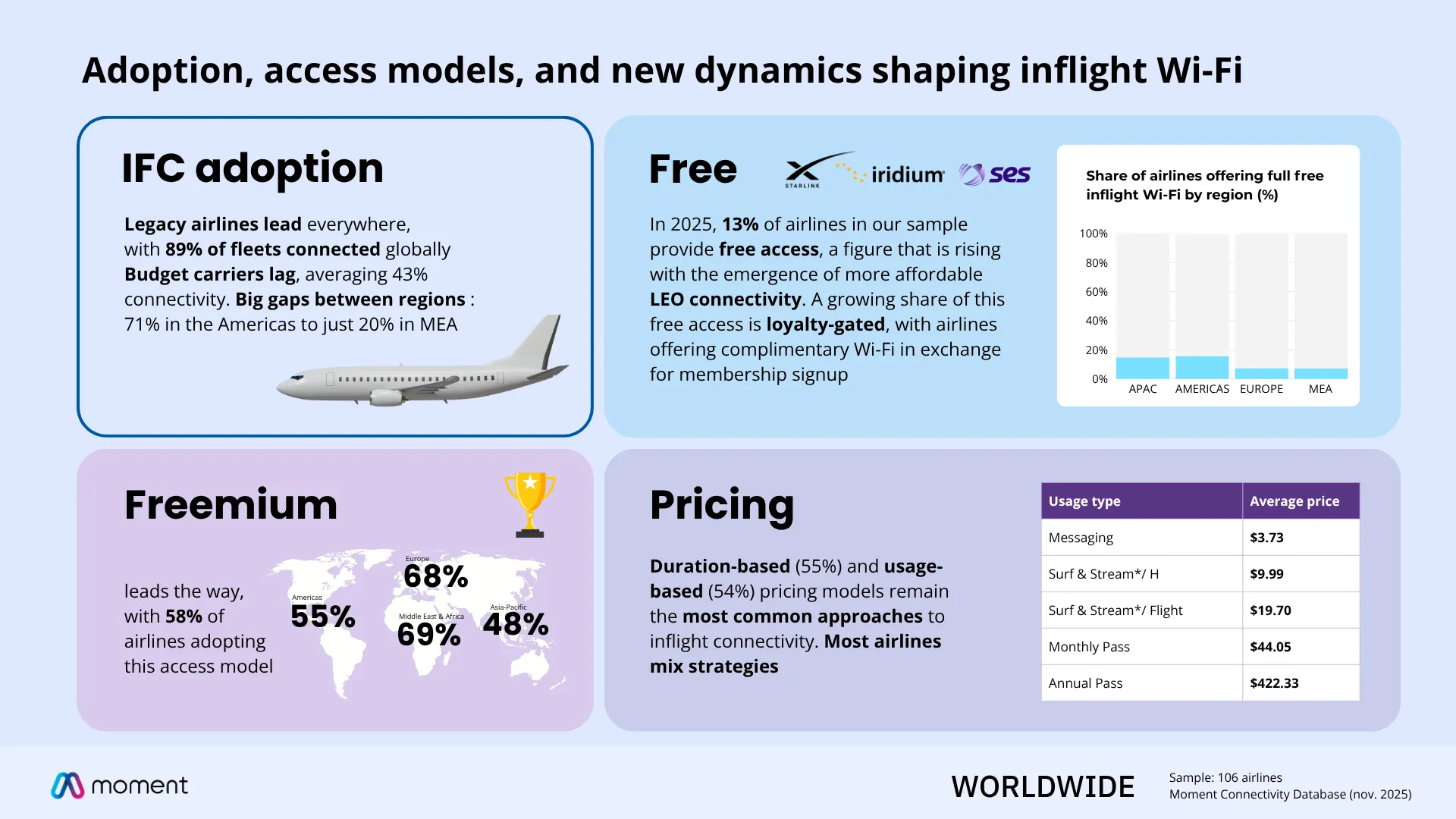
Duration-based and usage-based pricing are the two dominant approaches, applied by 55% and 54% of airlines respectively. The most common combination is duration plus usage (32% of airlines). Some carriers layer on a third variable: route-based pricing, distinguishing domestic from international flights.
- Messaging only: $3.73
- Browsing & streaming, hourly: $9.99
- Browsing & streaming, full flight: $19.70
- Monthly pass: $44.05
- Annual pass: $422.33
The Americas leads on subscription models. Europe on route-based pricing. MEA on duration tiers.
What the data tells airline and IFE teams
Budget connectivity is becoming table stakes. The Americas shows what maturity looks like at 71% LCC adoption. Europe and APAC are mid-cycle. Airlines that haven’t deployed connectivity are losing ground.
Loyalty-gated free access is the next default. As LEO satellite costs fall, the freemium ceiling moves. Airlines that haven’t mapped their access model against their loyalty programme are leaving CRM value behind.
Single-tier paid models are out of step with the market. 32% of airlines already mix duration and usage pricing. Complexity is increasing because passengers and commercial teams both demand it.
For airlines building or evolving their inflight connectivity strategy, the benchmark gives airline teams a structured reference for their own IFC decisions.
The full report includes airline-by-airline data, ISP partnerships, fleet adoption rates and complete regional breakdowns across the Americas, APAC, Europe and MEA. Used by IFE managers and strategy teams at airlines and IFEC vendors to benchmark their own position against the market. Free download.
Frequently asked questions
Is Wi-Fi standard on international flights in 2025?
On international routes operated by legacy carriers, yes — 89% of legacy airline fleets are partially or fully connected as of 2025. On budget carrier international routes, the picture is more variable: the global average is 43% connectivity adoption, ranging from 71% in the Americas to 20% in the Middle East and Africa. “Connected” also does not mean consistently reliable — coverage and quality vary by ISP, route geography, and aircraft type. Passengers on legacy carrier long-haul routes have a high probability of Wi-Fi access; passengers on budget carrier routes outside the Americas should not assume it. (Moment Connectivity Database, 106 airlines, Nov. 2025)
What percentage of airlines offer free Wi-Fi in 2025?
13% of airlines in the Moment global benchmark offer fully free inflight Wi-Fi across their connected fleet. However, this understates the trend: loyalty-gated free access — where connectivity is free for passengers who enroll in the frequent flyer program — is the fastest-growing model and is not captured in the “fully free” figure. In the Americas, 14% of budget carriers offer free Wi-Fi — the only region globally where budget airlines have adopted this model at scale. Free access is expected to expand as LEO satellite costs continue to decline, particularly in Europe where deployment is accelerating. (Moment Connectivity Database, 106 airlines, Nov. 2025)
How do airlines compare on inflight Wi-Fi pricing?
The global benchmark from Moment’s analysis of 106 airlines: messaging-only access averages $3.73, hourly internet $9.99, full-flight streaming $19.70, monthly passes $44.05. Duration-based and usage-based pricing are the most common structures, used by 55% and 54% of airlines respectively — most carriers combine both. Europe stands out for route-based pricing (domestic vs. international tiers); the Americas lead in subscription pass adoption. Airlines pricing significantly above these benchmarks without a premium product rationale face adoption headwinds; those pricing below without an advertising or loyalty offset are subsidizing a cost they cannot sustain at scale.
What makes inflight connectivity best-in-class in 2025?
Four variables distinguish best-in-class programs from the market average: fleet-wide consistency (not route-selective coverage), an operator-owned portal that puts pricing and access rule control in the airline’s hands rather than the ISP’s, loyalty integration that turns connectivity into a CRM acquisition tool, and the ability to generate ancillary revenue from the connectivity layer itself through advertising, retail upsell, and freemium upgrade paths. The ISP and satellite technology matter — but two airlines on the same ISP can deliver radically different commercial outcomes depending on whether they own their portal or lease it from the provider.
Discover our latest reports





Ready to redefine your journey with innovative solutions?
Start powering your digital journey with Moment.