
Rail Passenger Experience Report: Onboard Entertainment, Wi-Fi and Digital Service Trends
This report maps how rail passengers spend their time onboard: content consumption, Wi-Fi usage, digital service expectations and the infotainment levers that drive both passenger satisfaction and ancillary revenue for train operators.

Key findings
- 70% of train passengers on equipped routes experience regular Wi-Fi dropouts. Reliability — not availability — is the primary driver of low onboard platform engagement. (Moment Rail Report)
- Beyond two hours, onboard platform adoption shifts from optional to primary entertainment source. Journey length is the first filter for content investment decisions. (Moment Rail Report)
- Millennials are the dominant train passenger demographic — and they benchmark onboard digital services against their daily apps. Streaming, personalized content, and e-commerce are baseline expectations, not premium ones. (Moment Rail Report)
- Rail passenger traffic grows 11% between 2023 and 2028. Higher volumes amplify both the commercial opportunity and the NPS cost of a poor digital experience. (Moment Rail Report)
- Operators treating the onboard portal as a closed entertainment environment are leaving destination services, retail partnerships, and advertising revenue unrealized. Infotainment is evolving into a full commercial platform. (Moment Rail Report)
Rail passenger volumes are growing. Digital expectations are growing faster.
Global rail ridership is projected to reach 1.08 billion passengers in 2028, up from 970 million in 2023 (International Union of Railways, UIC). Worldwide passenger kilometers already exceed 3.7 trillion in 2025. Rail onboard infotainment and connectivity are no longer optional infrastructure: they are the baseline passengers bring from their daily connected environments. This growth is not evenly distributed across age groups: passengers aged 25 to 34 represent the largest segment onboard, followed by the 35 to 49 bracket. Rail is a young, connected market and the infrastructure investment backing it reflects that shift.
The European Union’s €750 billion Green Deal prioritizes sustainable transport. The US has committed $66 billion to rail improvements, including Amtrak expansion. China operates over 45,000 km of high-speed rail, with plans to reach 70,000 km by 2035. Night trains are seeing a parallel revival: SNCF’s Intercités night services carried 770,000 passengers in 2023, up 11% year-on-year. Longer journeys mean more time onboard and more opportunity to deliver value.
What rail passengers do onboard
On an average train trip of approximately four hours equipped with an infotainment platform, passengers generate an average session time of 48 minutes. Those 48 minutes are active: content consumption, service browsing, connectivity use.
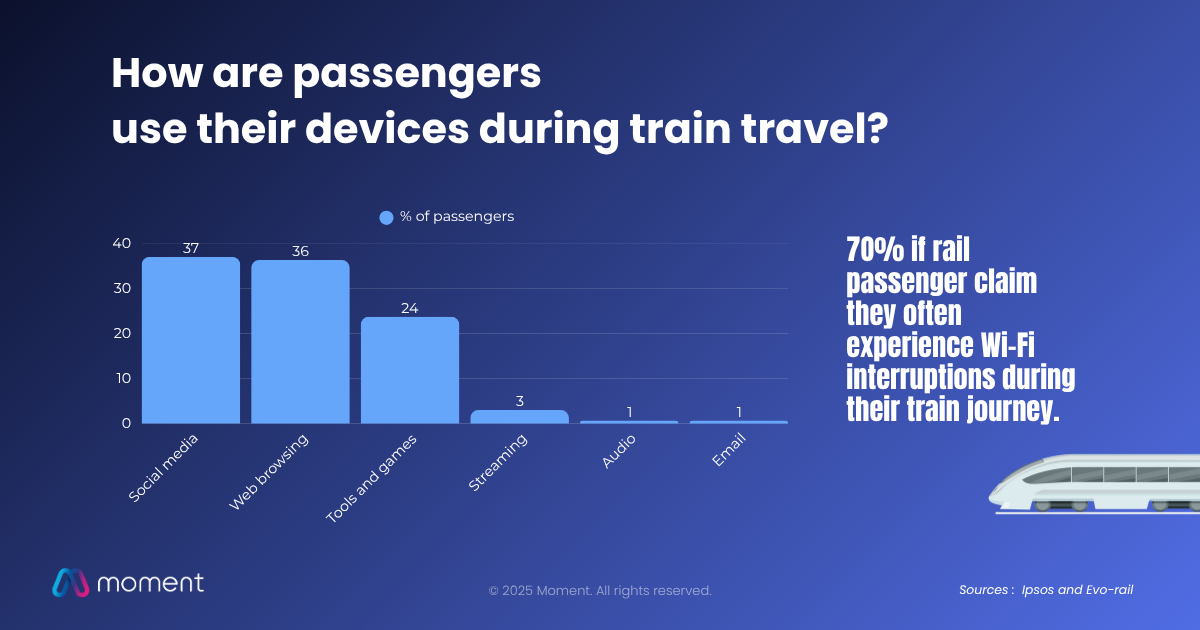
71% of passengers use smartphones onboard. 29% use tablets or laptops. The platform data covers engagement across video, press, games and audio, with consumption patterns that shift significantly by passenger profile, age group and journey type. Streaming on personal devices accounts for just 3% of activity, a signal that passengers are not satisfied with their own mobile data connection and are open to operator-provided alternatives when the quality is there.
The full content consumption breakdown by format, genre and passenger profile is in the downloadable report. For operators building or refreshing their onboard entertainment platform, the data maps directly to catalog and editorial decisions. For the 2025 session-level data across Moment’s European rail network, see the Rail Onboard Entertainment Trends 2026 report.
Wi-Fi: the gap between expectation and delivery
78% of rail passengers consider Wi-Fi availability a core requirement, not a differentiator. Yet 70% report experiencing regular connectivity interruptions during their journey (Ipsos and Evo-rail). The gap is not marginal. It is structural. Limited antenna access, speed-related latency and infrastructure constraints combine to degrade the experience passengers expect from their daily connected environments.
Rail operators competing with aviation on medium-distance routes and with cars on short-distance trips cannot afford connectivity quality becoming a negative factor in modal choice. Wi-Fi reliability determines operator ratings, not just network KPIs. A reliable Wi-Fi portal built for rail constraints is the operational foundation for everything else: retail, entertainment, loyalty, destination services.
From infotainment to ancillary revenue
The major European rail operators already deploy infotainment platforms. TGV inoui offers video, games, audio and press for Business Premier travelers. OUIGO sells a premium entertainment tier at €3. The model is proven across major European networks. For operators without a platform, the question is no longer whether to invest but how to structure the revenue model.
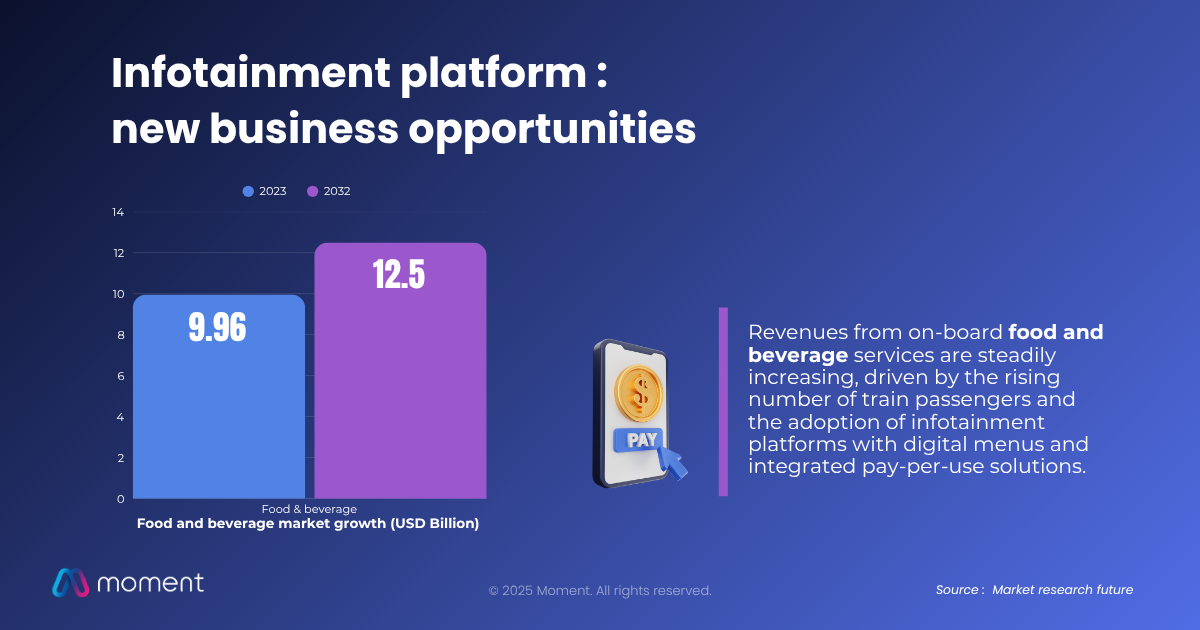
The onboard food and beverage market is projected to grow from $9.96 billion in 2023 to $12.5 billion by 2032 (Market Research Future), driven partly by digital ordering integrated into infotainment platforms. Beyond F&B, operators can layer destination services directly into the passenger journey: hotel reservations, museum tickets, event access, car rentals. The platform becomes a commercial channel that extends beyond the train itself.
Like airlines, rail operators can tie ancillary purchases to loyalty programs, creating a recurring revenue relationship with frequent travelers. The Mood platform supports this structure: entertainment, Wi-Fi access, retail and loyalty integration in a single operator-controlled environment. For operators looking at the broader rail passenger experience, the revenue framework and the operator-by-operator competitive breakdown are in the full PDF.

"Understand your audience first. Content must reflect Gen Z’s habits, family needs, and business travelers’ expectations."
Rail operator strategy: content, connectivity and revenue
Three areas determine whether an operator captures the value of onboard time or leaves it behind.
Content strategy: a single catalog does not serve a Gen Z passenger and a business traveler equally. Segmented editorial approaches drive both satisfaction scores and session length. The genre and demographic data to build that segmentation is in the report.
Connectivity quality: passengers who experience interruptions do not reduce their expectations. They reduce their rating of the operator. Wi-Fi reliability determines operator ratings, not just network KPIs.
Ancillary revenue architecture: destination services, digital F&B ordering and loyalty-linked purchases are deployable today. The operators generating revenue beyond the ticket price have built structured commercial touchpoints into the journey. The report maps how.
This infographic report is used by passenger experience teams and digital leads at rail operators to benchmark their onboard offer. It covers genre-level content data, a demographic breakdown by passenger profile and a competitive analysis of European operator platforms. Free download.
Frequently asked questions
How do rail operators increase onboard entertainment platform adoption?
The primary lever is connectivity reliability, not content volume. 70% of train passengers experience regular Wi-Fi dropouts — which forces them back to personal downloaded content regardless of what the onboard platform offers. Once reliability is addressed, platform adoption rises with content relevance: matching the catalogue to the dominant passenger profile on each route consistently outperforms generic catalogue expansion. Frictionless access — no login barriers, instant load — is the second highest-impact variable after reliability.
What is the ROI case for an onboard infotainment platform for train operators?
ROI comes from three sources simultaneously: NPS improvement on equipped routes (which correlates directly with repurchase rate), ancillary revenue from food ordering and digital retail, and advertising and partnership revenue from the onboard audience. The commercial window is determined by journey length — routes over two hours generate significantly more platform engagement and purchasing activity than short-haul routes. Operators who model ROI only on entertainment miss the ancillary and advertising revenue that makes the investment self-funding at scale.
How does Wi-Fi reliability affect passenger satisfaction on trains?
It is the most direct NPS lever in the digital cabin. Passengers who experience connectivity dropouts rate the overall journey lower regardless of seat comfort, punctuality, or content quality. 70% of train passengers on equipped routes experience regular dropouts — meaning the majority of the potential NPS benefit from connectivity investment is currently being offset by reliability failures. For operators benchmarking against other transport modes, reliable Wi-Fi is the baseline expectation, not a differentiator.
What content strategy works best for train passengers?
Route-level personalization outperforms a single catalogue for all lines. The dominant passenger profile varies by route — Millennials, business travelers, families — and content performance reflects that directly. Video leads engagement on longer routes; press and podcasts index higher for business travel corridors. Seasonal adjustments matter: lighter entertainment and short-form content outperform on holiday routes. Operators who treat their content catalogue as static are underperforming operators who update and curate by route and season.
Discover our latest reports




Ready to redefine your journey with innovative solutions?
Start powering your digital journey with Moment.