
European Rail Onboard Entertainment Benchmark: Wi-Fi, Content Platforms and Catalogue Depth Across 48 Brands
This benchmark covers 48 long-distance rail brands across 26 countries. It maps Wi-Fi adoption, onboard entertainment platform presence and catalogue depth across the market, verified at source.
This benchmark covers 48 long-distance rail brands across 26 countries, services with a typical journey of 90 minutes or more. Regional, commuter and non-European services are outside this panel's scope.
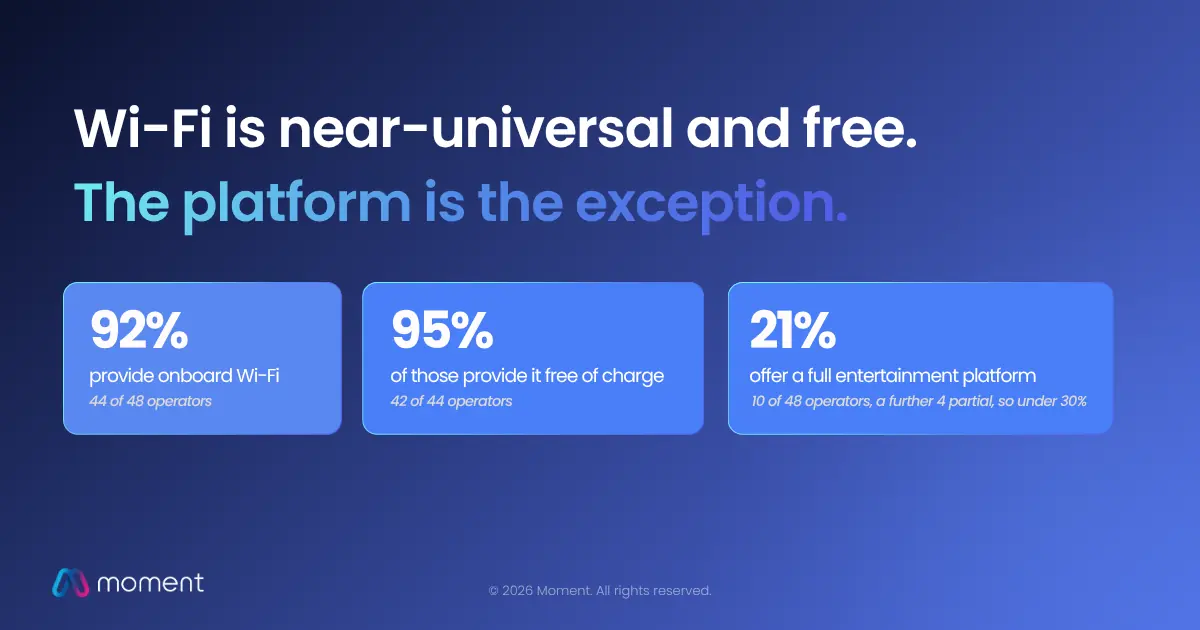
Wi-Fi is available on 44 of 48 European long-distance rail brands, and free on 42 of those. A full onboard entertainment platform is available on only 10, structured as a standing service rather than a one-off addition. The gap between connectivity and content is where this rail content platform market stands today.
Key findings
- 92% of long-distance rail operators provide onboard Wi-Fi (44 of 48). 95% of those provide it free of charge (42 of 44). (Moment Database, 2026 edition)
- OUIGO France and OUIGO España are the only two operators charging for Wi-Fi access. Both state the position openly, consistent with their fare model. (Moment Database, 2026 edition)
- 21% of operators run a full onboard entertainment platform (10 of 48), a further 4 partial. Combined, under 30% of the panel. Catalogue-level detail is available for 9 of the 10 full platforms. (Moment Database, 2026 edition)
- 8% of the panel (4 of 48) do not currently offer onboard Wi-Fi. For most, the budget went to rolling stock renewal or a cellular-first strategy instead. (Moment Database, 2026 edition)
Curious what passengers actually do with onboard content once it is available? See the companion report, Onboard Entertainment Trends in Rail, which looks at real onboard viewing behaviour rather than platform presence.
Free wifi is standard. Reliability is not.
As free Wi-Fi becomes the default across the panel, the differentiator shifts from whether an operator offers a connection to whether that connection holds up. That shift matters commercially: a passenger who expects Wi-Fi and loses it mid-journey notices the failure far more than one who never had it in the first place. Four technical constraints recur across the market:
- Tunnels. Signal drops sharply or cuts out entirely for the duration of the tunnel, with no mitigation possible from a purely terrestrial network.
- Antenna handover. Moving between relay antennas at speed can interrupt the connection if handover is not seamless.
- Passenger density. A full train concentrates demand on the same cell, congesting the network at the moment passengers use it most.
- Rolling stock shielding. Metal bodyshells and treated glazing, designed to insulate the cabin, also attenuate the signal passing through it.
For the 4 operators without onboard Wi-Fi, the pattern is budget priority rather than oversight: rolling stock renewal or a cellular-first strategy took precedence for most, while one cross-border operator faces a fleet leasing constraint.
None of these constraints disappear with better hardware alone, which is why Low Earth orbit satellite connectivity has entered the conversation. Italo aims to equip its full fleet with Starlink by 2027, following a year of testing at 300 km/h (Italo, February 2026). Renfe has committed 85 million euros across 183 trains to combine 4G, 5G and LEO satellite links (Renfe tender, August 2026). Both are meaningful commitments, not pilots. But satellite signal is blocked by tunnels just like cellular, so every deployment so far blends satellite with 5G rather than relying on it alone. The network layer keeps improving. It does not remove the case for what happens when the network fails anyway.
Hosting the entertainment platform onboard removes the dependency on the network
If the connection is the hard part, the answer is to stop relying on it for playback. When the content library is hosted on a server onboard rather than streamed live over the network, three things follow:
- Better Wi-Fi. Freed from competing with video for bandwidth, the network is left for browsing and messaging.
- Lower data costs. Video streaming is by far the heaviest consumer of network capacity, so hosting it onboard cuts costs directly.
- Uninterrupted playback. Content keeps running through tunnels, dead zones and congestion alike, the exact conditions described above.
The platform stops being a feature that depends on connectivity and becomes one that compensates for its limits.
Long-distance rail is where the onboard entertainment platform gap sits
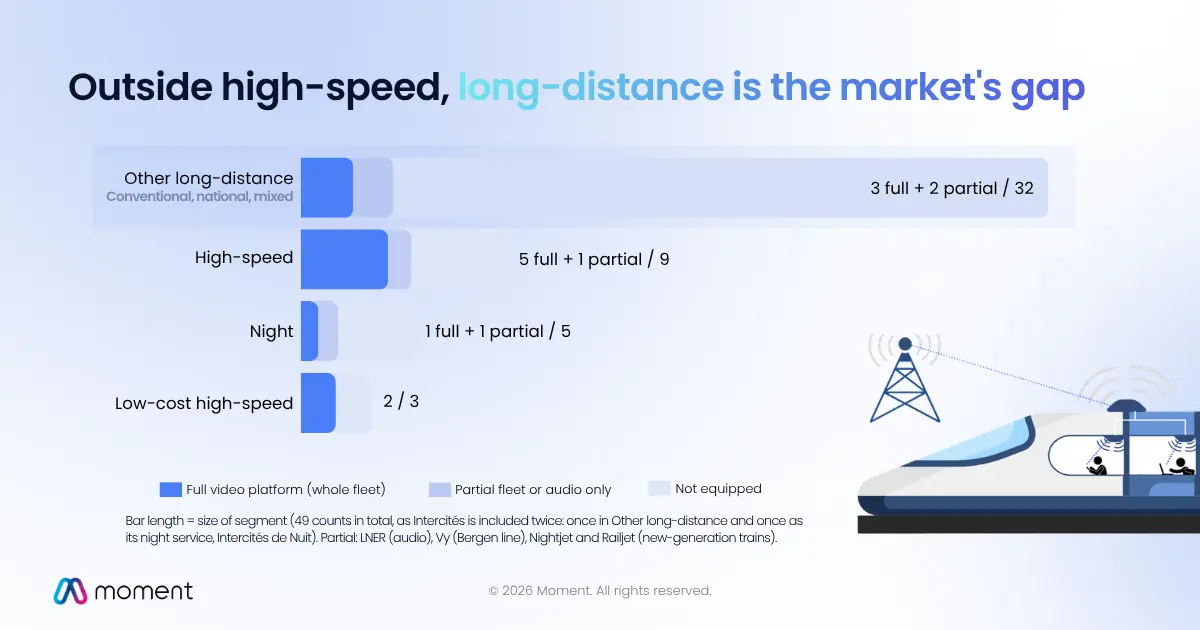
Onboard entertainment platforms concentrate almost entirely in premium and priced-up segments. High-speed brands run one on 5 of 9 lines, reflecting a branded, premium passenger experience where the platform reinforces the fare. Low-cost high-speed brands run one on 2 of 3, but structured as a paid add-on rather than a free perk, OUIGO being the clearest example: the platform there is priced like every other option on the fare, not bundled in. Night services sit close behind, at 2 of 5: Intercités de Nuit runs a full platform, and Nightjet a partial one, limited to its newest rolling stock.
This pattern echoes what already shows up in Wi-Fi adoption: investment follows commercial positioning, not journey length. An operator that competes on price, low-cost high-speed, still invests in the platform, because it monetises it directly. An operator competing on distance and price on a conventional route has, on this data, not yet found the equivalent case for doing so.
Outside these three segments, adoption drops sharply. Conventional and mixed long-distance brands run a full or partial platform on just 5 of 32, even though many of these journeys last as long as a high-speed trip, sometimes longer. A passenger on a 4-hour conventional long-distance service and a passenger on a 4-hour high-speed service have the same amount of time to fill. Only one of them is likely to have a platform to fill it with.
This is the single largest opening in the panel. It is not a niche gap: 32 brands sit in this segment, more than the high-speed and low-cost high-speed segments combined. For an operator running long-distance services outside the high-speed category, the data suggests the absence of a platform is closer to the market norm than the exception, which cuts both ways: little competitive pressure yet, but little cover either once a competitor moves first.
The full operator list behind these numbers, and what distinguishes the few conventional long-distance operators that have invested, is in the downloadable report.
Rail content platform catalogues range from 46 to 769 titles, but origin and recency define the experience
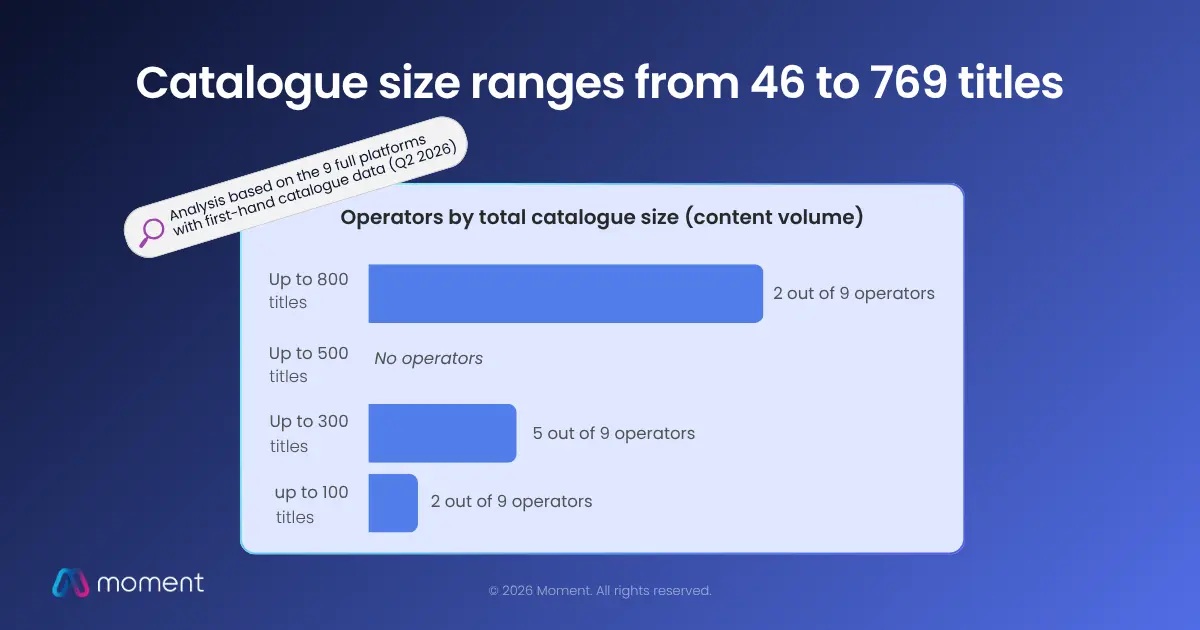
Among the 9 operators with first-hand Q2 2026 catalogue data, library size varies 17-fold, from 46 to 769 titles. The gap does not track passenger volume or operator type in any consistent way, which suggests the driver is not fleet size or budget so much as how deliberately the catalogue is curated.
Every one of these 9 platforms offers films and games, the two categories with no exceptions across the panel. Press and podcasts appear on most of the 9, series on fewer still, and how developed each category is, beyond simply being present, varies as widely as catalogue size does.
Origin and recency, not catalogue size, are what separate a catalogue passengers notice from one they do not:
- Similar size, different feel. OUIGO France and DB ICE hold a similar number of films, close to 30 each, yet 73% of OUIGO France's catalogue is recent, against 36% for DB ICE.
- Local content varies widely. Local-language content ranges from 14% to 93% across the panel, a spread that has nothing to do with how many titles an operator holds.
- Recency beats volume. An operator holding 300 titles, most a decade old, will likely underperform one holding 100 titles where half were released in the last two years.
The practical takeaway for an operator weighing where to invest isn't simply adding titles. It's getting the mix right: enough recent releases that the catalogue feels current, without losing the classics passengers still choose, and enough local content that the platform feels built for its own passengers rather than assembled from whatever was available.
The full operator-by-operator breakdown, category mix across all formats, origin split and recency, for all 9 benchmarked platforms, is in the downloadable report.
Where onboard entertainment platform investment goes next
Two openings remain largely unclaimed across this panel. The first is experience. Basic curation, offering a mix of genres and formats, is already table stakes: every full platform in this benchmark clears that bar. What isn't covered is personalisation and journey or destination relevance taken to a genuinely high degree, adapting the catalogue to where the train is headed or who is on board, rather than offering the same static library on every route. No brand in this panel has claimed that ground decisively yet, which means the operator who does moves first on a dimension competitors haven't started measuring.
The second is revenue. The onboard platform is still treated mostly as a cost centre across the panel. OUIGO is the only operator in this benchmark charging directly for access. But charging isn't the only lever available:
- Onboard advertising.
- Retail and buy-on-board.
- Tiered bandwidth or premium passes.
None of them require passengers to pay for the platform itself. Hosting content onboard also cuts costs directly rather than generating revenue, since less of what passengers watch has to travel over the network, an operational saving that compounds every journey, every day. Rail has barely started exploring any of these levers, on either side of the ledger.
The operator-by-operator data behind every figure in this benchmark, including the segments and catalogue breakdowns not covered here, is in the full report.
Frequently asked questions
What percentage of European rail operators offer onboard Wi-Fi?
92% of the 48 long-distance rail brands benchmarked (44 of 48) provide onboard Wi-Fi. Of those, 95% (42 of 44) provide it free of charge. OUIGO France and OUIGO España are the only two that charge for access, consistent with a fare model where every option is priced separately. For the remaining 4 operators without Wi-Fi, budget priorities explain the gap more than technical limits: most redirected spend toward rolling stock renewal or a cellular-first strategy, and one cross-border operator faces a fleet leasing constraint. Together, these figures show Wi-Fi has become the default expectation across the panel, not the differentiator it still was a few years ago.
What percentage of European rail operators offer a full onboard entertainment platform?
21% of the benchmarked brands (10 of 48) run a full onboard entertainment platform, with a further 4 running a partial one, bringing the combined total to under 30%. Investment concentrates in premium and priced-up segments: high-speed brands run one on 5 of 9 lines, low-cost high-speed on 2 of 3, and night services on 2 of 5. Outside these segments, adoption drops sharply, with conventional and mixed long-distance brands running a platform on just 5 of 32, despite journeys of comparable length. Catalogue-level detail is available for 9 of the 10 full platforms, the tenth confirmed as full but outside this round's data collection. The gap between Wi-Fi adoption (92%) and platform adoption (21%) is where competition in this market now concentrates.
What is the difference between a full and a partial onboard entertainment platform?
A full platform runs fleet-wide with a complete video-led catalogue, available to every passenger on every service the brand operates. A partial platform is more limited: it can mean the service runs only on part of the fleet, as with Nightjet's deployment restricted to its newest rolling stock, or that it's limited to a single format rather than a full catalogue, as with LNER's podcast-only offer. Vy is another example, with entertainment limited to its Bergen line rather than the wider network. Of the 48 operators benchmarked, 10 run a full platform and 4 run a partial one, together representing just under 30% of the panel. The distinction matters commercially: a partial deployment signals early investment without full commitment, while a full platform reflects the onboard experience being part of the brand's core offer.
Which rail segment has the most onboard entertainment platforms?
High-speed and low-cost high-speed services lead adoption, running a full or partial platform on 5 of 9 and 2 of 3 lines respectively, followed closely by night services at 2 of 5. Outside these three segments, adoption drops sharply: conventional and mixed long-distance brands run a platform on only 5 of 32, even though many of these journeys last as long as, or longer than, a high-speed trip. This concentration in premium and priced-up segments suggests platform investment currently follows commercial positioning rather than journey length or passenger dwell time. It also means the market's largest segment by brand count, conventional long-distance, is also its least equipped. For an operator in that segment, the data points to comparatively little competitive pressure today, but also little cover once a competitor moves first.
Why do so few rail operators offer a full onboard entertainment platform?
Investment concentrates where the onboard experience already reinforces a commercial promise: premium high-speed branding, a paid low-cost fare structure, or a night service where passengers spend hours on board. Conventional and mixed long-distance operators, even on journeys of equivalent length, have invested far less, making this the single largest gap identified in the panel. Cost is one factor, but not the only one: a full platform requires committing to a catalogue strategy, not just installing hardware, and that commitment has so far tracked brand positioning more closely than budget availability. The result is a market where 92% of operators have solved connectivity, but only 21% have moved on to solving content. That gap is where the next phase of competition in rail onboard experience is likely to play out.
Discover our latest reports




Ready to redefine your journey with innovative solutions?
Start powering your digital journey with Moment.