Why train Wi-Fi quality changes when you cross a border
Cross a border and your train Wi-Fi can look completely different. Here's what's actually behind it, and what operators can do.

Train Wi-Fi speeds vary by more than 150 times across Europe. Sweden's trains deliver a median download speed of 64.6 Mbps. The Netherlands delivers 0.4 Mbps. Cross a border between the two networks, and passenger experience changes completely, not because the train changed, but because the country did.
This isn't a hardware problem. It's a policy and infrastructure problem, and rail IT and infrastructure leads need to know which parts of it they can actually influence.
Why wifi quality drops the moment you cross a border
Data from Ookla's Speedtest Intelligence, covering Q2 2025, shows the scale of the gap. Sweden leads Europe with a median download speed of 64.6 Mbps, more than four times the 15-country European median of 7.6 Mbps. Switzerland (29.8 Mbps), Ireland (26.3 Mbps) and Czechia (23.4 Mbps) also clear 20 Mbps. France sits close behind at 19.1 Mbps.
At the other end, the Netherlands records a median of just 0.4 Mbps, followed by Austria (0.7 Mbps), the UK (1.1 Mbps) and Spain (1.5 Mbps).
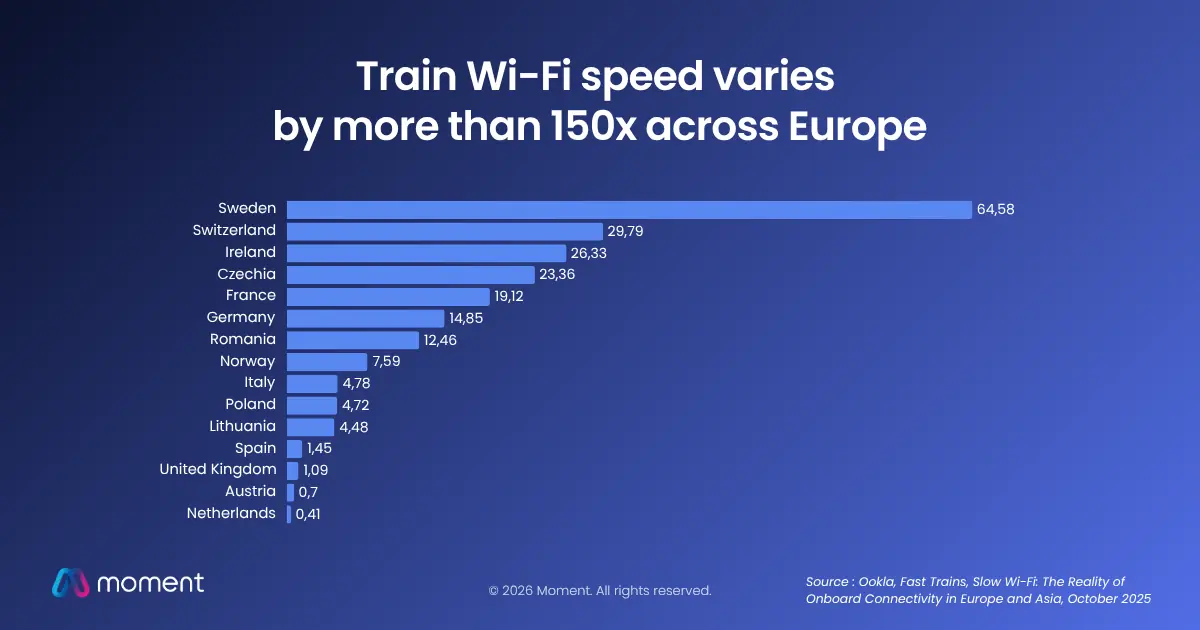
Train Wi-Fi speed varies by more than 150x across Europe. Source: Ookla Speedtest Intelligence, Q2 2025.
Luke Kehoe, industry analyst at Ookla, points to policy rather than geography as the deciding factor. Sweden pairs modern onboard equipment with early investment in FRMCS, the 5G-based rail communications standard, and targeted 5G upgrades along its rail routes. Its regulator has also extended coverage obligations and licensed low-band spectrum with explicit rural coverage requirements.
The result: a deep mobile coverage layer that trains can draw on for backhaul. Countries that treat rail corridors as priority coverage zones see fewer dead zones and fewer handover failures. Countries that don't, don't.
For a Head of IT or Infrastructure watching a dashboard where signal quality swings from strong to unusable at a border crossing, this reframes the question. The variance usually isn't a fault in the onboard platform. It's a gap in national telecom infrastructure and regulatory pressure that no onboard system, however well configured, can fully close on its own.
What rail operators actually control, regardless of national infrastructure
National infrastructure gaps are real, but they aren't the whole picture. What happens onboard still shapes how passengers experience a weak signal zone. Three levers sit entirely within the operator's control.
- Offline content caching. Preloading video, news and entertainment content onto the onboard platform means passengers keep watching even when the connection drops, instead of staring at a buffering wheel.
- QoS prioritization. When bandwidth is scarce, the platform can prioritize latency-sensitive traffic, like video calls or streaming, over background downloads, so the available signal serves what passengers actually notice.
- Managed passenger expectations. A portal that signals "entering a low-coverage zone" and switches passengers to offline content proactively reads as reliable. A silent drop reads as broken.
None of this fixes a weak national network. What it does is decouple perceived reliability from the underlying infrastructure quality, which is the part of the experience an operator can actually move without waiting for a telecom regulator to act.
A real case: one border, two networks
TGV Lyria, the joint SNCF-SBB service connecting France and Switzerland, illustrates the point directly. A single international route crosses one border, linking two national networks with different regulatory and infrastructure histories.
On average, 65% of TGV Lyria passengers connect to the onboard Wi-Fi portal, and 33% of them are looking for more entertainment options, according to data cited by Moment. TGV Lyria selected Moment to run its onboard Wi-Fi portal and content service, sourcing and curating a library of more than 150 titles in French, German and English, then delivering it as fully preloaded, offline content. Entertainment plays the same way regardless of which country's network the train is currently on, because it never depends on that network in the first place.
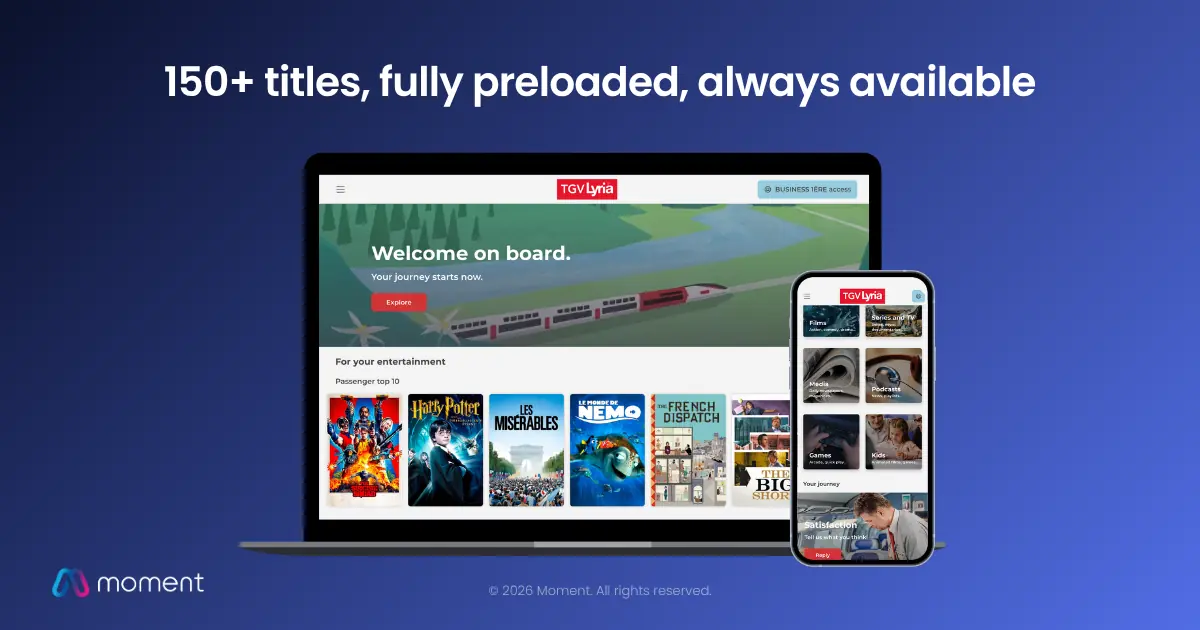
TGV Lyria's onboard content runs independently of network conditions, powered by Moment's Wi-Fi portal and content service.
The network doesn't change at the border. With the right onboard architecture, the passenger experience doesn't have to either.
Rail infrastructure investment moves on a multi-year timeline set by national regulators, not by any single operator. See how Moment's onboard Wi-Fi portal and content service help rail operators like TGV Lyria decouple passenger experience from national connectivity gaps.
Frequently asked questions
Is train wifi quality an infrastructure issue or the entertainment platform's fault?
Usually infrastructure. Wide swings in speed between countries, as much as 150 times according to Ookla's Q2 2025 data, are driven mainly by national telecom coverage and regulatory investment, not by the onboard entertainment platform.
Why is train wifi so slow in some countries?
Countries with slower median speeds, including the Netherlands, Austria, the UK and Spain, generally haven't treated rail corridors as priority mobile coverage zones. Analysts point to policy choices, like spectrum licensing and coverage obligations, as the main driver, more than raw geography.
Why is train wifi good on one side of a border and bad on the other?
Because the two sides sit under different national networks, shaped by different regulatory and investment histories. The onboard train doesn't change at the border. The mobile network it relies on does.
Can rail operators improve wifi satisfaction without waiting for national infrastructure upgrades?
Yes, within limits. Offline content caching, QoS prioritization and clear passenger communication about coverage zones all improve perceived reliability, even when the underlying network quality stays the same.

Discover our latest news



.webp)



%20(6).png)
%20(1).png)
%20(3).png)
%2520(6).png)
%2520(9).png)
.png)










Ready to redefine your journey with innovative solutions?
Start powering your digital journey with Moment.