Ferry entertainment system: what operators need to know
Ferry passengers have 4 hours and nothing to watch. Here is what a modern onboard entertainment system includes and what to ask before you buy one.
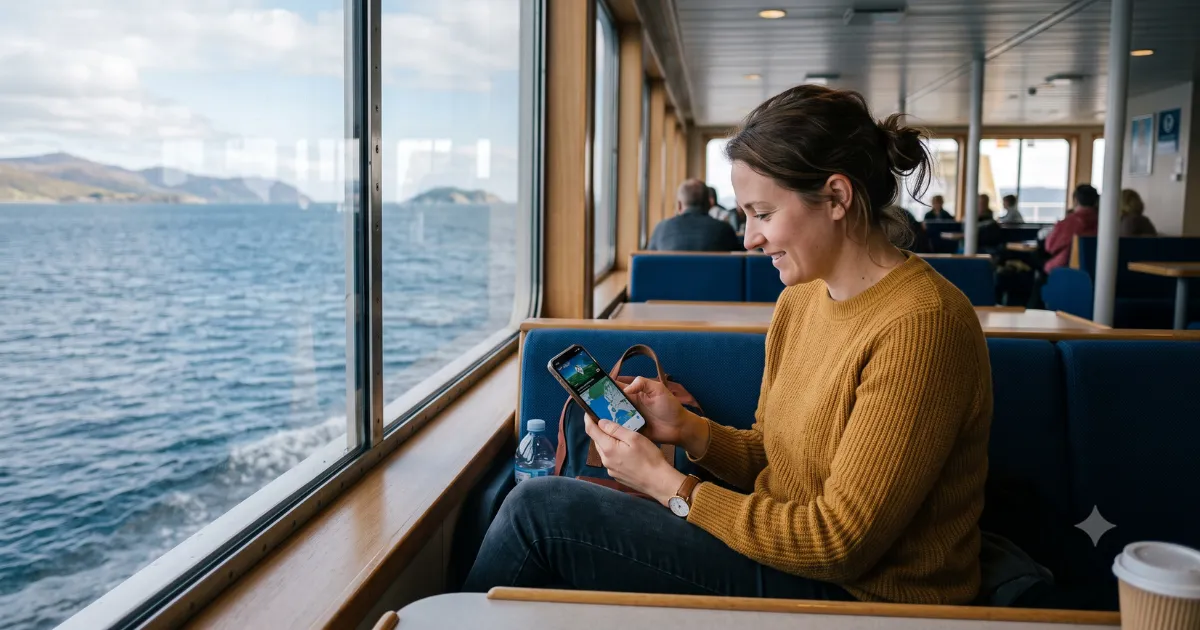
A 4-hour crossing is not a waiting room. Operators who treat it like one are leaving revenue and loyalty on the table. Ferry onboard entertainment has evolved: a modern system delivers video on demand, connectivity management, and passenger services from a server installed onboard, without requiring live internet to function. This guide covers what it actually includes, what makes ferry deployment operationally distinct, and what to ask before selecting a vendor.
What happens during a ferry crossing
Passengers board with different needs. Families with children need something to occupy the kids within the first 20 minutes. Commuters on a regular route want fast Wi-Fi and a portal that loads without friction. Tourists on a scenic or international crossing want content about the destination.
The gap most operators face is structural. Many ferries offer either nothing digital, or a portal that depends on live internet, which cuts out on open water. The result: passengers fall back on cellular, which also drops. Boredom and frustration compound. Revenue opportunities are missed.
The fix is not installing more screens. It is deploying a system that works offline, across multiple devices, without relying on live satellite connectivity to function.
What does a ferry entertainment system actually include?
A ferry entertainment system is not a single product. It is a modular platform hosted on a server onboard the vessel, combining content, connectivity, services, and operator communication in one interface.
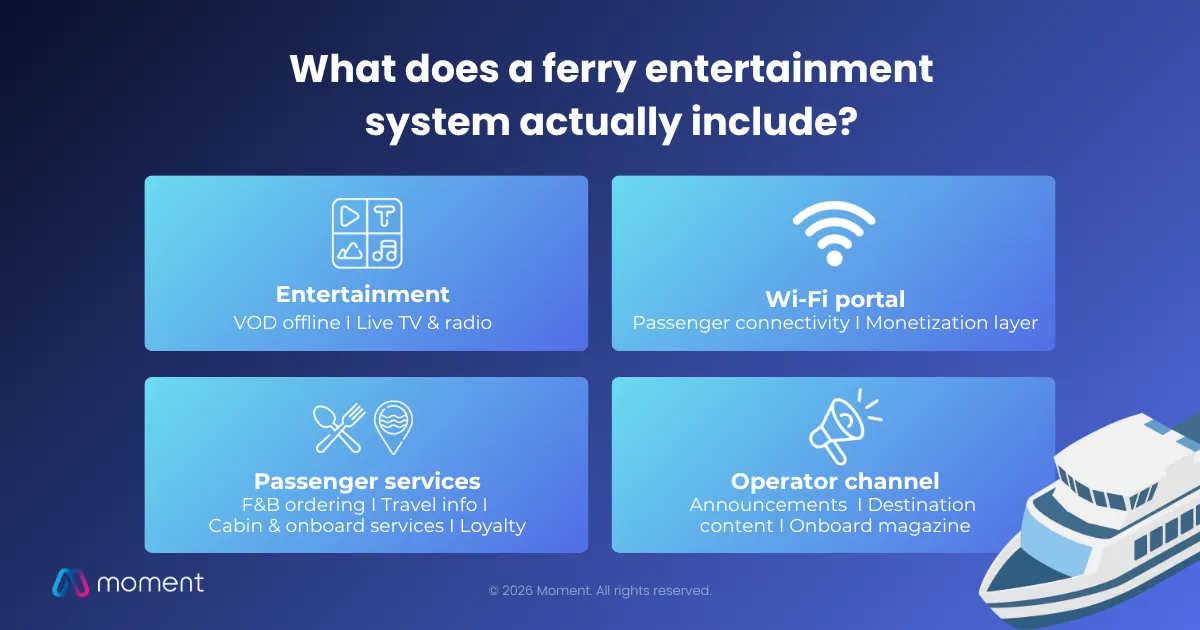
The core modules of a modern ferry entertainment system
Entertainment
VOD offline. Films, series, documentaries, children’s content, podcasts, music, digital press, and games are preloaded on a local server. Passengers access them from their own devices via the ship’s Wi-Fi, with no live internet required for the core experience.
Live TV and radio, when connectivity is available. On routes with reliable satellite, operators can offer linear broadcast channels alongside on-demand content. On open-water routes, the offline VOD library carries the experience independently.
Wi-Fi portal
Connectivity access for passengers and crew. The portal handles authentication, session control, and bandwidth allocation across the vessel. On ships with paid connectivity, it is also a direct revenue point. Wi-Fi portal
Passenger services
F&B ordering. Passengers browse a menu and order food and beverages from their seat or cabin without queuing. Most relevant on crossings of 4 hours or more, where onboard dining generates meaningful revenue.
Travel information. Moving map, estimated arrival time, port details, and local weather at the destination. Particularly valuable on international or scenic routes where passengers are preparing for what comes next.
Cabin and onboard services. On vessels with cabins, passengers can manage their booking, request services, or upgrade directly from the portal. Relevant on overnight crossings.
Loyalty. Operators can integrate their loyalty programme into the portal, allowing passengers to check points and access member benefits during the crossing.
Operator channel
Onboard promotions and announcements. The operator pushes messages, offers, and service highlights directly to the passenger interface, managed remotely from shore. A direct communication channel with a captive audience at sea.
Destination content. Guides to the port of arrival, local activities, and practical travel information. Adds genuine value on tourist and international routes where passengers are thinking ahead.
Digital onboard magazine. The operator’s own editorial content: vessel presentation, crew stories, route highlights, seasonal features. Turns the portal into a branded experience, not just a content library.
Ferry deployment has its own constraints
Every vessel and route combination is different. There is no standard configuration.
Multi-deck coverage. A vessel carrying 1,000 passengers across multiple decks requires a Wi-Fi architecture planned for that structure. Server placement and access point distribution are vessel-specific.
Route variability. An operator running 45-minute hops and overnight crossings on the same fleet needs a system that serves both. Short-hop passengers need instant, frictionless access. Overnight passengers need a richer library, cabin screen integration, and potentially live TV.
Passenger mix. Foot passengers with smartphones, car passengers who remain in their vehicles, families, tourists, and regular commuters all interact with the system differently. A well-designed platform serves all of them through the same interface.
Offline-first is not optional. Open-water connectivity is unreliable. Any system that requires live internet for core entertainment is not fit for ferry operations.
What does a real ferry deployment look like?
Brittany Ferries connects France, the United Kingdom, Spain, and Ireland. With crossings averaging 3 to 8 hours, onboard experience is a genuine commercial differentiator.
As part of its fleet renewal strategy, Brittany Ferries deployed Moment’s MOOD platform. The solution covers video on demand, more than 50 live French and British TV channels, and multi-device access across passenger smartphones, tablets, and in-cabin Smart TVs. Content is available in French, English, and Spanish.
The deployment started on three vessels: Pont-Aven, Salamanca, and Santoña. Based on passenger feedback and operational performance, Brittany Ferries extended the service to three additional ships: Saint-Malo, Galicia, and Guillaume de Normandie. Six vessels are now equipped. Each carries approximately 1,000 passengers per crossing.
Read the full case study to see how the deployment was structured.
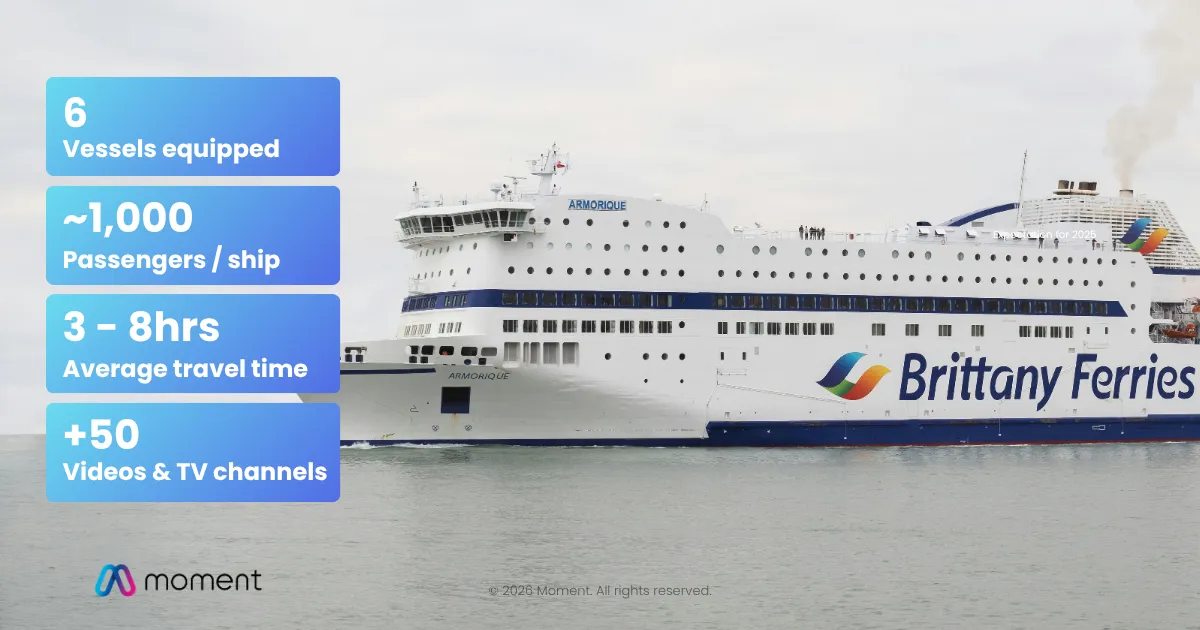
Brittany Ferries x Moment: deployment at a glance
“Video on demand is an important step we have taken to meet the demands of passengers for our newest vessels. This is why we turned to Moment. Content is now accessible from personal devices and TVs on board, delivering a more enjoyable journey for all passengers, particularly on longer routes, such as those connecting Spain with the UK.”
Joëlle Croc
Director of onboard customer experience at Brittany Ferries
What to ask when evaluating a ferry entertainment system
Before issuing an RFP or inviting vendors to present, ask these five questions.
Does it work offline, or does it require live internet? The answer determines whether the system actually works on your routes. Any dependency on live satellite for the core entertainment experience is an operational risk.
Can it be branded to reflect our identity? The portal is a passenger-facing product. It should carry your brand, your language, and your content, not a generic interface.
How is content updated? Remote delivery via over-the-air updates is standard on modern platforms. Understand the update frequency, the content catalog scope, and who manages licensing.
Does it integrate with our onboard F&B and payment systems? If your vessel operates a restaurant or bar, this integration is a direct revenue question. Ask for a live demo, not a slide deck.
Who has deployed this on ferries specifically? Ferry operations require ferry experience. Ask for named references in maritime, not repurposed deployments from other transport modes.
Discover how Moment equips ferry operators with end-to-end onboard entertainment, from content and VOD to Wi-Fi portal and passenger services.

Discover our latest news


.webp)

%20(6).png)
%20(1).png)
%20(3).png)
%2520(6).png)
%2520(9).png)
.png)









Ready to redefine your journey with innovative solutions?
Start powering your digital journey with Moment.