
How Brittany Ferries Runs Free Onboard Entertainment on 6 Vessels
See how Brittany Ferries runs free ferry onboard entertainment across 6 vessels, with or without a live connection to shore.
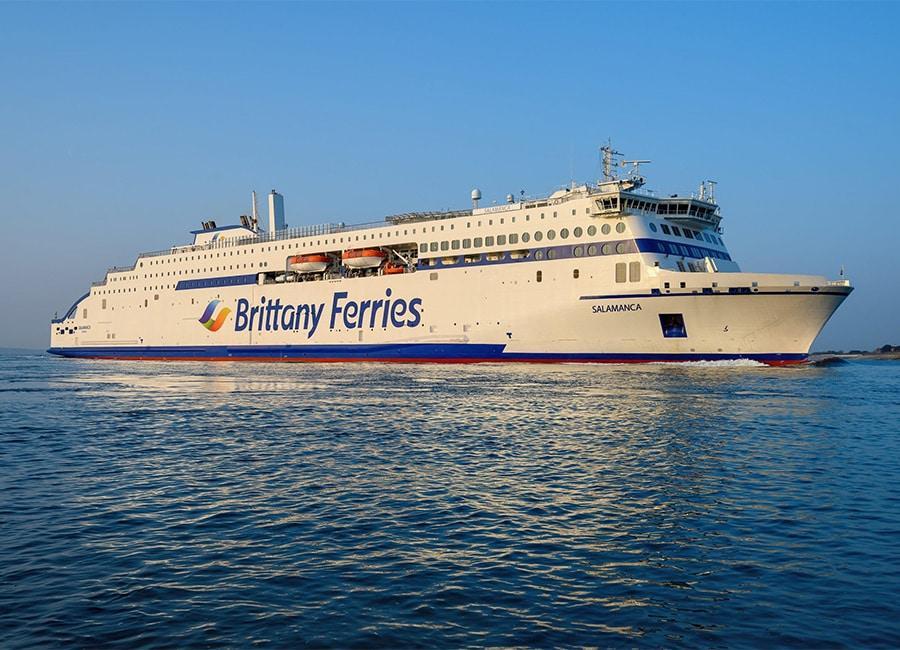
A crossing on Brittany Ferries can last six hours, or more than thirty. Somewhere on that open water, the satellite link to shore can drop, and it doesn't come back on request.
That is the constraint behind the ferry onboard entertainment system deployed across six vessels in the fleet. It has to keep running whether or not the ship is connected.
Key findings
- Free for every passenger. No paywall, no app to download. Cabin or not, access runs through the ship's Wi-Fi.
- Deployed across 6 vessels. Pont-Aven, Salamanca, Santoña, Saint-Malo, Galicia and Guillaume de Normandie all run the same system.
- Long crossings mean far more viewing. Passengers watch roughly 5 times more content on a long crossing than a short one: more than 3 hours per passenger versus around 40 minutes.
- Winter is the peak season, not summer. Consumption runs roughly 2.5 to 3 times higher in winter than summer, on both long and short crossings.
- VOD keeps running without internet. If the connection to shore drops, video on demand still works from the onboard server. Live TV needs the satellite link to receive its channels.
- Entertainment traffic runs on its own network. It is physically separated from the ship's business IT systems.
The operator
Brittany Ferries was founded in 1972. Today the company operates 13 ships across 12 ports in four countries: France, the UK, Spain and Ireland, carrying close to 2 million passengers a year alongside freight. The clientele is majority British leisure travellers, with families dominating summer sailings and couples and retirees more common off-season. The fleet is in the middle of a modernisation programme that includes two hybrid LNG-electric vessels, Saint-Malo and Guillaume de Normandie, Europe's two largest hybrid ferries, which entered service in 2025.
"My role is to design and deploy new ideas that add real value for our passengers, and keep improving the experience on board."
Steven Perrot
Head of Commercial Project Development, Brittany Ferries
The constraint: long crossings and a connection that can't be guaranteed
Crossing length varies widely by route. Spain routes run longest: Salamanca takes 26 to 33 hours, Santoña and Galicia between 20 and 30 hours, sometimes up to 34. Channel and Irish routes are shorter: Saint-Malo runs 7.5 to 11 hours, Guillaume de Normandie around 6, and Pont-Aven between 6 and 20 hours depending on season.
The passenger mix shifts with the season, and the satellite link to shore can drop at any point on open water. Neither is something the onboard ferry entertainment system can control. It has to keep working regardless.
"One of our biggest constraints is autonomy. If the link to shore breaks, the solution still has to keep working."
Nicolas Remond
Technical Project Manager, Brittany Ferries
What the ferry onboard entertainment system includes
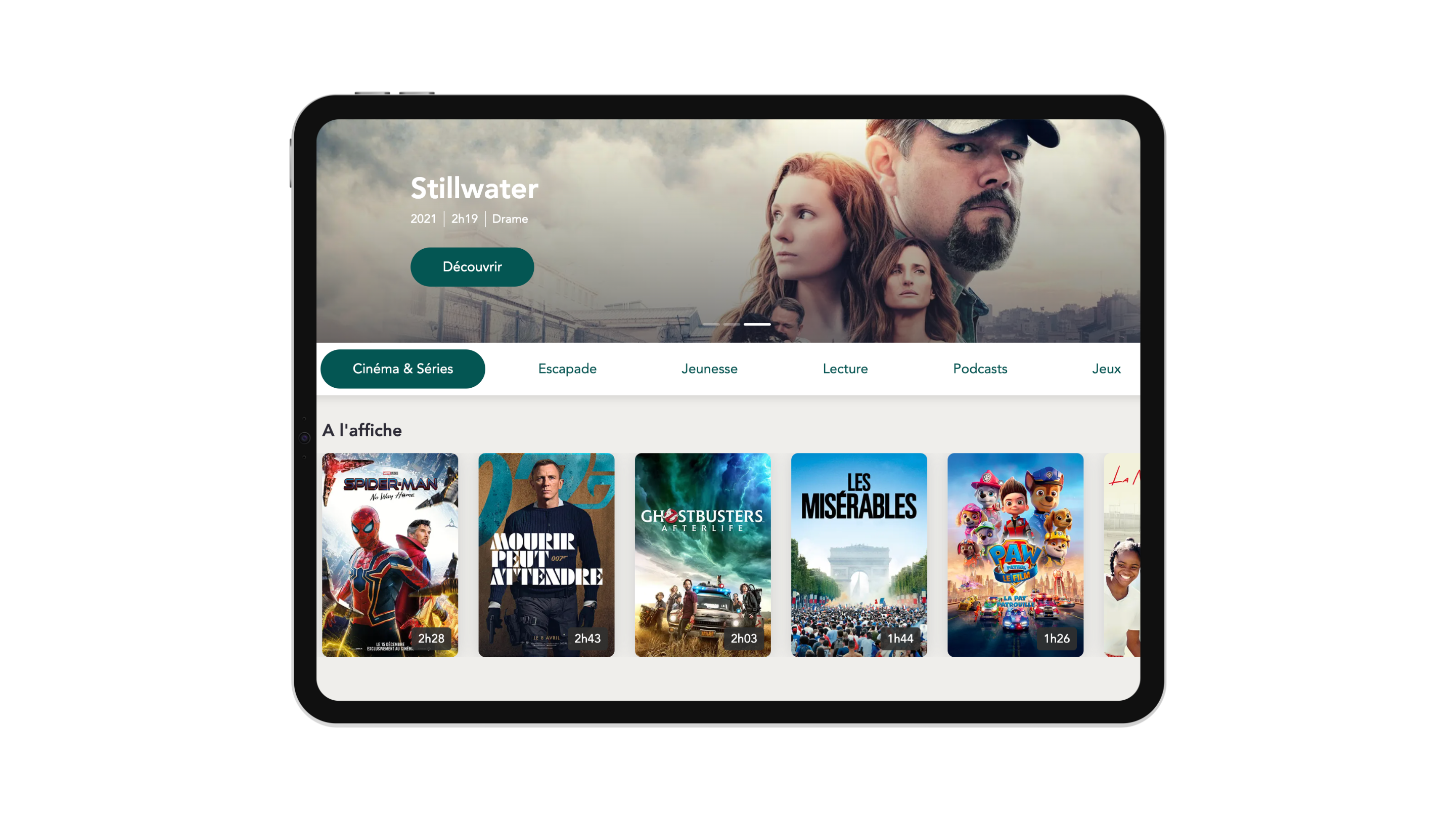
The system includes free video on demand, films, documentaries, series, children's content and games, alongside podcasts and audiobooks, plus more than 90 TV and radio channels combined, across all languages. Passengers can access content either via cabin TVs on long crossings, or on their own devices over Wi-Fi on any crossing. Everything runs in French, English and Spanish. The servers are supplied by Moment's onboard entertainment platform, with the satellite antenna feed sitting above the Moment server in the same rack, connected through the ship's Wi-Fi portal.
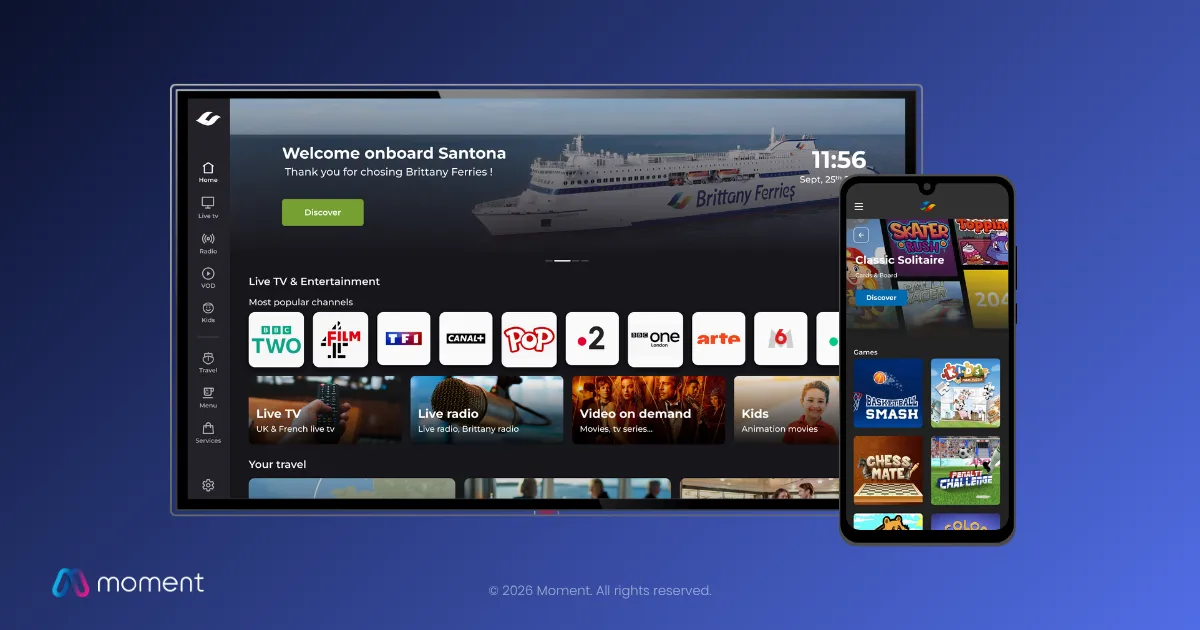
The same free catalogue is available on cabin TVs and on passengers' own devices via the ship's Wi-Fi — no app, no paywall.
The architecture: built to keep running on its own
The Moment server delivers video on demand without needing an internet connection. Live TV needs the satellite link to receive its channels, so it depends on the connection to shore. Redundant VOD servers with automatic failover keep the service available, since a ship runs 24 hours a day, seven days a week. Entertainment traffic sits on its own network, separate from the ship's IT systems that run point of sale and back office operations. A network port in a passenger cabin has no direct path to the operator's business servers.
"We run two separate networks on board. One is our IT network, for office systems and tills. The other is OT, which only carries cabin TV and passenger-area entertainment. If someone ever tried to attack us through a network port in a cabin, there's no direct path to our business servers."
Loïc Malfait
Electronics Officer, Brittany Ferries
What passengers actually watch
Moment's onboard analytics across the six-vessel Brittany Ferries deployment show that crossing length, not the age of the ship, drives how much passengers watch.
- Long crossings mean far more viewing. On crossings running 20 to 34 hours, passengers watch more than 3 hours of content on average, against around 40 minutes on short crossings of 6 to 11 hours, roughly 5 times more.
- Winter is the peak season, not summer. On long crossings, average consumption rises from around 2 hours per passenger in summer to more than 5 hours in winter. On short crossings, it rises from around 25 minutes to more than an hour. The pattern holds on both route types, roughly 2.5 to 3 times higher in winter.
- Winter adds the most where usage is already high. In absolute terms, the winter increase is far larger on long crossings, adding around 3 hours, than on short ones, which gain around 50 minutes. It amplifies an already high usage on long routes, and turns a marginal one into a real one on short routes.
- The likely driver is the off-season clientele. Couples and retirees, more common outside summer, are probably more captive than summer families. Shorter days and worse weather likely play a role too, with passengers spending more time indoors. This is a plausible explanation, not a confirmed cause.
The takeaway: the service creates the most value in the months when the operator carries the fewest passengers.
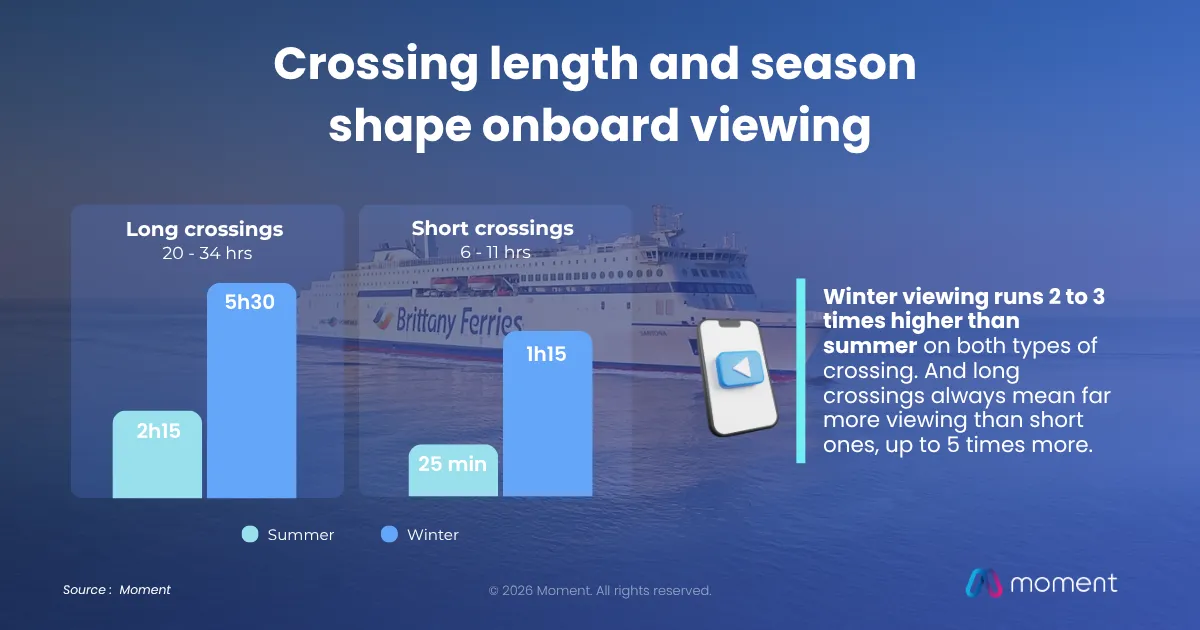
Viewing time per passenger across six Brittany Ferries vessels, measured on all passengers — users and non-users combined. Winter runs 2 to 3 times higher than summer on both route types.
Films are watched far more than documentaries or series. Cabin TVs see far more use than personal devices on long crossings; on day crossings, personal device usage picks up noticeably. What passengers mention most isn't the range of content. It's that the service is simple, and that it's free. Most didn't expect it.
"What I liked was that it's free and simple. On a long crossing, it's genuinely nice to have that in your cabin, and to choose your own films."
Célia
Passenger, Brittany Ferries
Getting it used: crew and passenger adoption
Moment and Brittany Ferries run onboard crew training sessions so staff can guide passengers who aren't sure how to start. Passenger communication runs across three moments: pre-boarding, through the website, email and onboard magazine; onboard, through screens and physical signage; and at ferry terminals, where staff act as a first point of contact.
"I use it on two levels: explaining it to passengers, and watching it myself in my own cabin. For the crew, it's a real moment of entertainment, and it keeps us from feeling completely cut off from what's happening on shore."
Pierre Le Manach
Chief Purser, Brittany Ferries (Santoña)
Why Moment was selected
Brittany Ferries names three criteria behind the choice: robustness, price and support. Moment (moment.tech) works with transport operators on the passenger experience, with deep experience in disconnected and low-connectivity environments, serving 150M+ passengers a year across aviation, rail and maritime.
"We've built real trust with the Moment teams. Communication between the two sides is good, and our onboard teams stay in direct contact with theirs. That closeness matters on a ship that runs every day, around the clock."
Steven Perrot
Head of Commercial Project Development, Brittany Ferries
Watch the teams at Brittany Ferries and Moment describe the deployment.
See how Moment equips ferry and cruise operators.
Frequently asked questions
Is onboard entertainment free on Brittany Ferries?
Yes. Video on demand and live TV are free for every passenger, with or without a cabin. There is no paywall and no app to download. Access runs through the ship's Wi-Fi, on cabin TVs or personal devices depending on the crossing.
How is a ferry entertainment system kept separate from the ship's IT network?
The entertainment platform runs on its own network, separate from the systems handling point of sale and back office operations. A network port in a passenger cabin has no direct connection to the operator's business servers, so an issue on one side can't reach the other.
How much do passengers watch on a long crossing?
On long crossings, running 20 to 34 hours, passengers watch more than 3 hours of content on average, about 5 times more than on short crossings. Consumption is also markedly seasonal: on long crossings, it rises from around 2 hours in summer to more than 5 hours in winter.
Does ferry entertainment work when there's no internet at sea?
Partly. Video on demand runs from the onboard server and keeps working without a connection to shore. Live TV needs the satellite link to receive its channels, so it depends on the connection being up.
Can passengers without a cabin use the service?
Yes. The entertainment system is free for every passenger, whether or not they have a cabin. Access runs through the ship's Wi-Fi on personal devices.

Discover our case studies


.png)


Ready to redefine your journey with innovative solutions?
Start powering your digital journey with Moment.