Starlink for airlines: what it means for your Wi-Fi portal strategy
Starlink solves connectivity. See what airlines still need to control above it, from Air France’s Flying Blue model to ISP-agnostic portal strategy.

Does an airline running Starlink still need a separate Wi-Fi portal? The short answer is: it depends on whether you want to own the passenger experience above the connectivity pipe, or hand it over to your satellite provider. Starlink solves bandwidth. It does not solve who gets access, on what terms, with what data, and under what brand.
The deployment pace makes the question urgent. United expects close to 1,000 Starlink-equipped aircraft by the end of 2026, a full year ahead of its original schedule. Southwest operated its first Starlink commercial flight on June 22, 2026. British Airways went live in March 2026, Virgin Atlantic in May 2026, and American Airlines will bring Starlink to more than 500 narrowbody jets starting Q1 2027. More than 36 airlines worldwide are now engaged with the technology. This is no longer an early-adopter story. It is the new baseline for inflight connectivity.
What Starlink solves, and what it doesn’t
Starlink solves the pipe problem: bandwidth, latency, coverage, and cost of connectivity. Its low Earth orbit constellation delivers speeds and consistency that legacy geostationary systems could not match, including over oceans and polar routes.
What it does not solve are the portal questions. Who gets access, and under what conditions. What data is collected, and who owns it. What the passenger sees first when they connect, and whether that moment reinforces the airline’s brand or someone else’s. These are not technical questions about the satellite link. They are commercial and governance questions about everything that happens above it.
Do airlines using Starlink still need a Wi-Fi portal?
Starlink’s commercial model in aviation tends toward a frictionless, direct-to-passenger offer: free internet, gate to gate, minimal intermediation. For a smaller airline, the path of least resistance is to install Starlink, switch on free Wi-Fi, and stop there. No portal, no monetization layer, no data.
Air France took a different path. Starlink provides the connectivity, but access runs through Flying Blue, the airline’s loyalty program. The service is free for all Flying Blue members, and passengers without an account can create one onboard in a few clicks. As of mid-2026, the rollout covers roughly 60% of the fleet, with full coverage targeted by the end of the year.
The choice is not Starlink versus portal. It is whether an airline wants to own the experience above the pipe or outsource it to the connectivity provider.
What the portal layer does that Starlink doesn’t
A Wi-Fi portal sits above the connectivity layer and handles everything Starlink was never designed to manage. SpaceX’s default commercial position pushes for zero-friction access, with no captive portal, no loyalty login, and no branded gate standing between the passenger and the connection. But the Air France and United examples show this default is negotiable, not absolute. Both airlines kept their own authentication layer in front of Starlink, gating access through Flying Blue and MileagePlus respectively. Delta, by contrast, reportedly walked away from a Starlink deal specifically over this point, unable to secure the level of portal control it wanted, and chose Amazon Leo instead.
That authentication layer is also where the airline’s commercial strategy lives. Air France uses its Wi-Fi portal to distribute a free one-week Apple TV trial to connecting passengers, a third-party content partnership that exists entirely because the airline, not Starlink, controls who sees what on first connection. The same gate that recognizes a Flying Blue member can just as easily surface a duty-free offer, a destination services upsell, a food and beverage promotion, an ad, or a partner brand experience. None of that commercial logic runs through the satellite link itself.
The portal also carries the operational layer Starlink doesn’t touch. It enforces quality of service, protecting premium cabin tiers when bandwidth is shared across the aircraft. It gives the airline commercial data and analytics: who connected, what they engaged with, conversion by offer type, none of which Starlink reports, even though Starlink itself provides detailed network telemetry per aircraft and per access point, covering bandwidth, connected devices, throughput, and outages. And for airlines running more than one connectivity provider across the fleet, whether GEO on some routes and LEO on others, the portal is what keeps the passenger experience consistent regardless of what sits underneath.
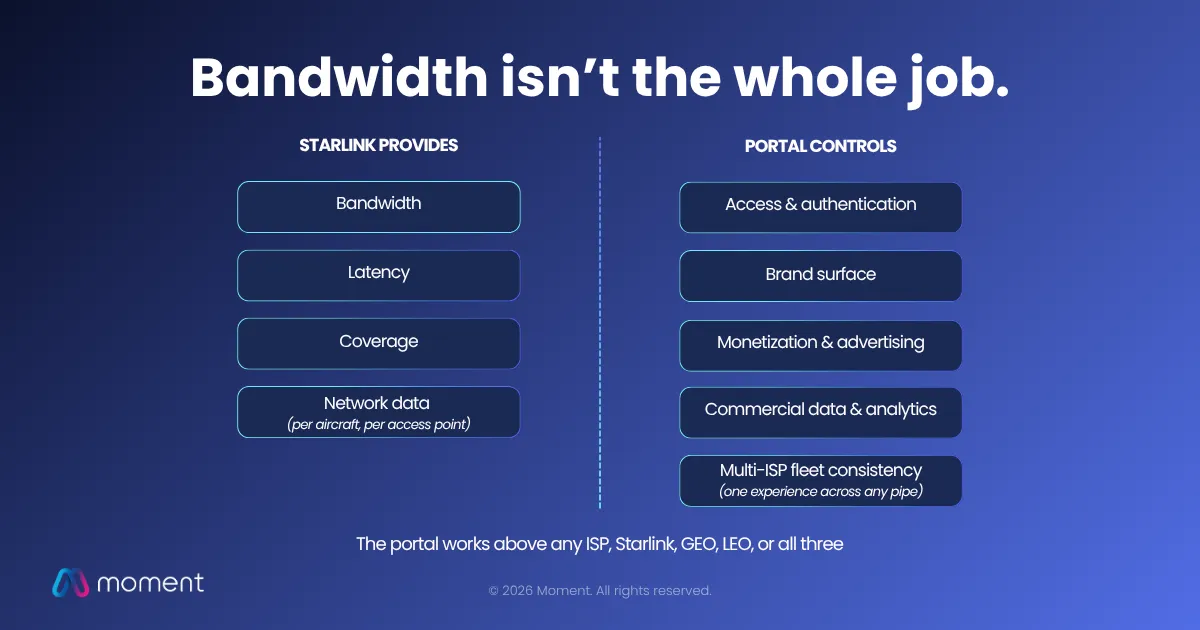
Connectivity vs portal control
Why an ISP-agnostic portal matters when Starlink isn’t the last ISP
Airlines switching connectivity providers, or operating mixed fleets during a transition, need a portal that does not have to be rebuilt every time the pipe changes. A portal bundled with a specific ISP creates switching costs that compound the next time the connectivity contract changes, whether that means moving away from Starlink or adding a second provider for a different part of the fleet.
An ISP-agnostic portal survives Starlink. It survives the next LEO provider. It survives the multi-ISP fleet reality that most large carriers already operate. For an IFE and Connectivity Manager building the case internally, this is the argument that holds regardless of which satellite provider wins the next negotiation: the portal is the layer the airline controls, independent of what connects it. The full breakdown of access models, governance, and the 10 questions to ask before choosing a portal is in Moment’s Wi-Fi Portal Playbook.
Moment’s Wi-Fi portal works across any ISP, including Starlink, with full airline control over access, monetization, and passenger experience.

Discover our latest news



.webp)


%20(6).png)
%20(1).png)
%20(3).png)
%2520(6).png)
%2520(9).png)
.png)










Ready to redefine your journey with innovative solutions?
Start powering your digital journey with Moment.