4 Trends Shaping the Rail Passenger Experience in 2026
Discover four key trends shaping the onboard passenger experience in 2026, from hybrid Wi-Fi to check-in/check-out ticketing, for a seamless journey.
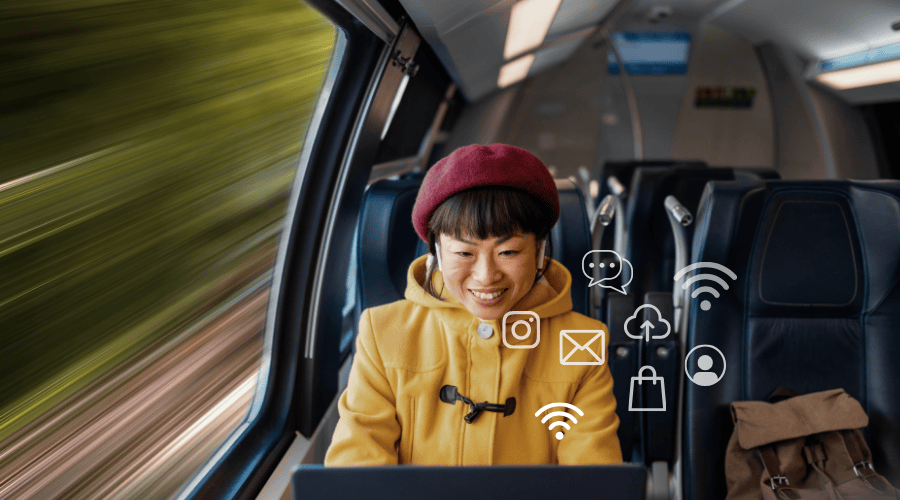
The rail industry is entering a transformative phase where digital passenger experience has become as important as on-time performance. Connectivity, entertainment, and onboard services are no longer add-ons; they shape comfort, satisfaction, and ultimately preference between operators.
Wi-Fi, in particular, is increasingly perceived less as a “nice-to-have” and more as a basic utility. Yet performance remains uneven. Ookla/Speedtest-based analyses published in 2025 highlighted huge gaps across a set of European markets, ranging from around 64.6 Mbps median download speeds in the best-performing country (like Sweden) to roughly 0.4 Mbps in the lowest-ranked one (like Netherlands). Meanwhile, investment is accelerating: Valour Consultancy estimates passenger Wi-Fi could scale from around 12,000 trains today to 37,000 by 2034, driven partly by LEO satellite and trackside improvements.
In 2026, the winners won’t be the operators who simply “have Wi-Fi”. They’ll be the ones who design a stable digital journey that still delivers value when coverage doesn’t. Here are four trends showing how the onboard experience is being rethought, from infrastructure choices to interface design and seamless journey flows.
1. Onboard passenger experience that works like home
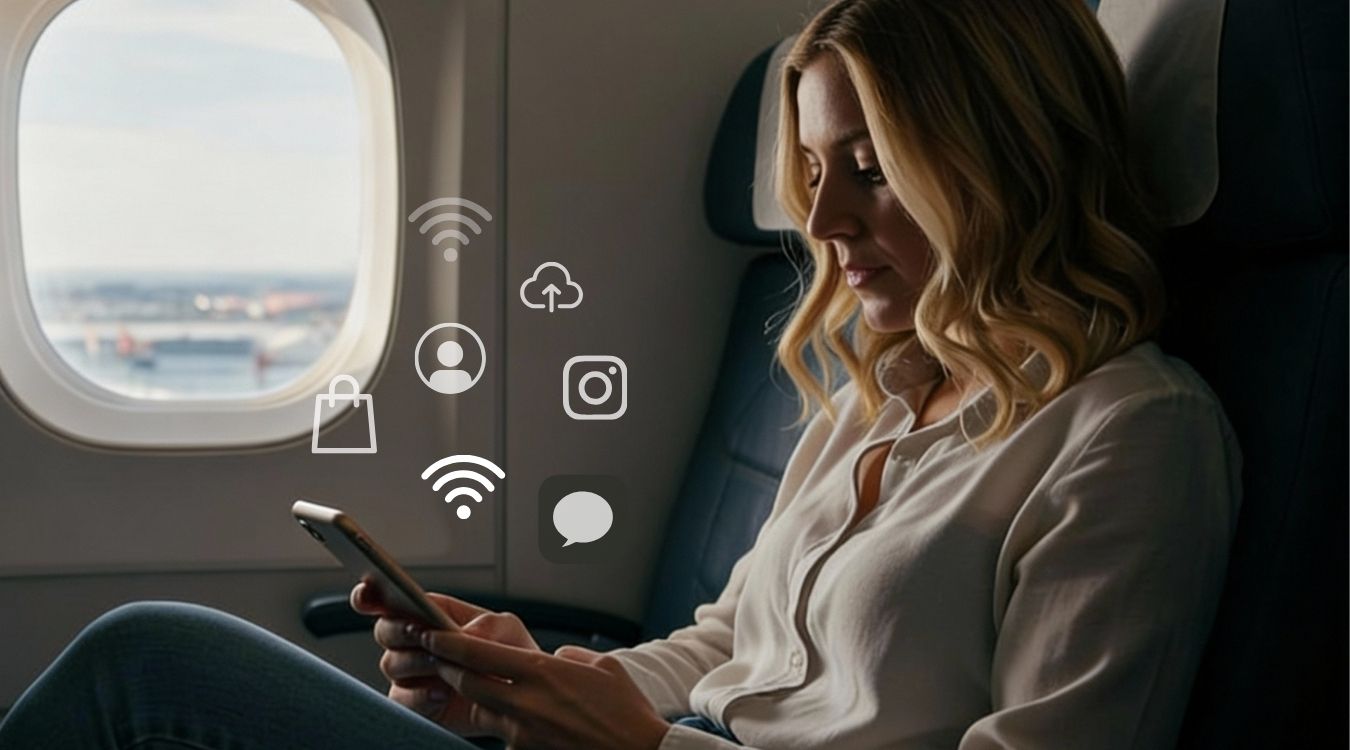
Onboard time has become valuable time, and it’s increasingly mixed-use. In a single trip, passengers may search, scroll, message, stream, and work, often switching between those behaviours in minutes. Anonymised traffic analysis shared for World Wi-Fi Day reveals this shift clearly: Google tops bandwidth usage, followed by social platforms like Instagram, streaming services including Netflix and YouTube, and messaging apps led by WhatsApp.
That mix makes one thing clear: the old assumption that “train Wi-Fi is mainly for business email” is outdated. It also changes what “quality” means. Passengers don’t judge peak speeds in perfect conditions; they judge whether the experience feels consistently usable across the whole route.
That expectation sets up the next trend: if consistency is the benchmark, then connectivity strategies must be built for resilience, not just speed.
2. Hybrid rail connectivity (cellular + LEO + trackside)
For years, rail connectivity was marketed as a speed race. In 2026, that framing is outdated. The winning strategy is resilience: maintaining stable passenger experience as trains move through varying coverage zones.

Brightline in Florida deployed this approach in April 2025 on the Miami-Orlando route. Where cellular coverage proved inconsistent, they combined LEO satellite connectivity with McLaren Applied’s 5G Edge Active Antenna and intelligent link aggregation. The goal wasn't hitting peak speeds but ensuring passengers could stream and work without interruption.

ScotRail launched a similar trial on six trains serving remote Highland routes, using a LEO satellite network in partnership with Clarus Networks to improve connectivity where traditional networks struggle. The benefits extend beyond passenger Wi-Fi to include crew communication, GPS tracking for coordinated transit connections, and real-time access to onboard security footage.
Those examples show where the market is heading: hybridisation and redundancy. However, Valour’s The Future of Connectivity in Rail (2025) stresses that satellite performance degrades when the train’s line of sight to the sky is repeatedly blocked by tunnels, dense urban corridors with high-rise buildings or rolling terrain.
That’s why the real direction of connected travel is not “100% satcom”, but hybrid, with intelligent switching between links, and an onboard experience that doesn’t collapse when backhaul does.
If backhaul can’t be perfect everywhere, the interface passengers rely on must become the stable centre hub.
3. Onboard connectivity portal as service hub
In 2026, the Wi-Fi portal is no longer just a captive step used to authenticate passengers. It’s increasingly designed as the on-train digital home screen: a single entry point where passengers connect, understand their journey, and access onboard services and infotainment without hunting across multiple apps or links.
This shift matters because passenger needs are converging. Real-time alerts, disruption updates, connections, ticketing access, customer support, feedback, and entertainment are all becoming digital-first. Operators need one consistent interface that works on personal devices, loads fast, and remains usable even when backhaul is unstable.
Personalisation makes the difference. Modern onboard entertainment platforms adapt based on route type, journey length, time of day, and passenger preferences. Commuters see real-time alerts and connection information first. Long-distance travelers get entertainment libraries and onboard services prioritized. This transforms the portal from a connectivity layer into a scalable platform for information, communication, feedback, and service discovery, while still doing the basics (authentication, consent, access tiers) cleanly and frictionlessly.

In late 2025, Queensland Rail introduced an onboard portal on its Electric Tilt Trains that lets passengers access licensed entertainment, live maps, and safety information via a dedicated onboard network, clearly positioning the portal as more than an internet gateway.
In Europe, SNCF Voyageurs presents the Portail TGV INOUI as the destination passengers are redirected to after connecting to onboard Wi-Fi, reinforcing the idea of a central hub for onboard digital content and services.
But the journey doesn’t begin onboard, buying ticket must enter in the seamless digital strategy experience to start the journey at the first passenger touch point.
4. Invisible ticketing : digital pay-as-you-go
Ticketing is shifting from a pre-trip transaction to an in-trip digital flow.
In the UK, the Department for Transport launched 2025 trials where passengers check in and check out in an app, the journey is tracked via GPS, and the system automatically charges the best fare at the end of the day, with a barcode generated in-app for inspections and barriers.
This is more than a ticketing experiment, it's a new mental model where the journey becomes a continuous digital session.
When passengers experience "travel first, pay later" simplicity, they expect the rest of their journey to behave similarly. No friction, no repeated logins, no disconnected systems.
In 2026, rail passenger experience won’t be won by adding more features, but by delivering continuity across mixed passenger behaviours, uneven real-world coverage, and a journey that is increasingly digital end to end.
What operators should do in 2026 ?
- Measure quality of experience, not Mbps (portal load time, drop rate, abandonment).
- Deploy hybrid connectivity + edge caching (cellular + trackside + LEO + embedded).
- Make the portal the single interface for info, content, services.
- Ensure end-to-end continuity from ticket purchase to arrival (one login/session).

Discover our latest news



.webp)

%20(6).png)
%20(1).png)
%20(3).png)
%2520(6).png)
%2520(9).png)
.png)




Ready to redefine your journey with innovative solutions?
Start powering your digital journey with Moment.