4 Trends That Will Transform Aviation Passenger Experience in 2026
In 2026, airlines will compete on seamless Passenger Experience, not features. Discover four inflight trends reshaping Wireless IFE, inflight connectivity, onboard retail, and content strategy.

Global air traffic has returned to pre-pandemic levels, with continued growth expected beyond 2025, according to ACI World. However, the most important shift is not quantitative but behavioral.
The aviation industry is entering a fully digital age. The majority of travelers have grown up interacting daily with online technologies, shaping fundamentally different expectations of service and experience. According to SITA*, more than two-thirds of passengers are now digitally savvy (68%), comfortable with self-service, mobile-first interactions, and real-time digital environments.
In 2026, passengers will no longer accept a fragmented journey. They expect a digital-first, seamless experience, where services, information, and engagement remain consistent from check-in to landing. Airlines are no longer evaluated flight by flight, but on their ability to deliver a coherent, reliable passenger experience across the entire journey.
This shift places new goals on inflight systems. A well-designed In-Flight Entertainment and Connectivity (IFEC) ecosystem can reduce stress, restore a sense of control, and maintain engagement even during disruptions. However, a disconnected or unreliable inflight experience frustrates passengers and weakens loyalty to the airline.
As a result, airlines are no longer competing on novelty. In 2026, they compete on experience stability, efficiency, and continuity.
*“Air travel for a digital age” SITA
1. Smartphone becomes the control center
The mobile phone is no longer just a booking or check-in tool. It has become the primary interface through which travelers manage their entire journey*, from loyalty identification to payments, support, and post-trip interactions.
This shift is closely linked to the Travel Mixology**. Travelers no longer rely on a single platform or brand. They move between tools: using AI to explore destinations and compare options, turning to social platforms for lived experience, and engaging with airline or travel-brand assistants to refine their choices. The smartphone acts as the control layer, connecting these sources into a coherent journey.
In 2026, this behavior accelerates as new integrations make it possible to move seamlessly from inspiration to booking, sometimes without even choosing a destination upfront. Planning becomes more flexible, personalised, and resilient, blending machine efficiency with human authenticity.
For airlines, the implication is clear. Passengers do not reset their journey when they board, they expect continuity. Inflight systems must therefore be BYOD-first and aligned with mobile usage patterns, extending the same digital logic from ground to air. When inflight experiences feel disconnected from the ground ecosystem, they create friction, whereas when they integrate naturally, they can reinforce confidence and control.
*IATA’s 2025 Global Passenger Survey
**Amadeus Travel Trends 2026
2. Inflight connectivity becomes infrastructure
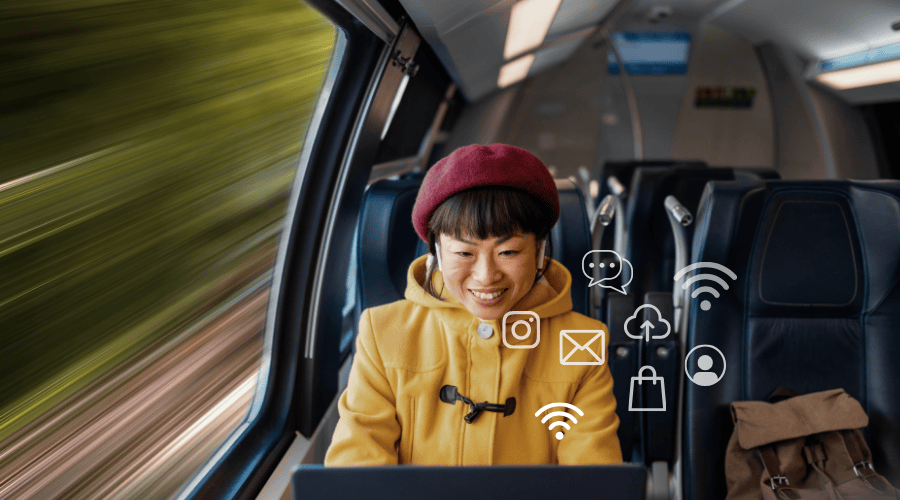
Inflight connectivity has shifted from a differentiator to a basic expectation. Passengers no longer ask whether Wi-Fi is available onboard, they assume it is. Connectivity is now considered an integral part of infrastructure, rather than a premium feature.
It’s again a matter of tolerance. Connectivity is no longer judged on advertised speeds, but on reliability and continuity. Messaging must work, browsing must remain usable, and digital services must stay accessible throughout the flight. From the passenger’s perspective, inflight connectivity is simply part of a continuous digital journey that starts on the ground and is expected to persist in the air.
Technology is valued for its ability to support seamless, end-to-end experiences, and inflight connectivity remains structurally constrained by bandwidth, coverage, and cost, creating a gap between expectations and technical reality.*
To bridge this gap, airlines are moving toward hybrid IFEC architectures, combining cloud services with edge computing, onboard processing, and local content caching. This approach ensures that core services and content remain available even during connectivity gaps, delivering a more stable and predictable passenger experience.
In this model, inflight connectivity becomes the backbone of a broader passenger experience, supporting Wireless IFE, digital services, and onboard retail.
*Amadeus blog Nov 2025
3. Personalisation + AI drive ancillary growth
Airlines are moving decisively beyond the traditional “ticket + bag” model toward true airline retailing. Ancillary revenues now represent a structural growth lever, increasing year over year and accounting for around 14.5% of total airline revenues globally in 2025.*
In this context, ancillary revenue growth is no longer driven by adding more products, but by making offers more relevant, more contextual, and better timed across the passenger journey including onboard.
Seats, baggage, food and beverage, duty-free, destination services, and connectivity are increasingly bundled, unbundled, and recombined through dynamic offers. What determines performance is no longer the breadth of the catalog, but the airline’s ability to match the right offer to the right passenger, at the right moment.
This is where data and AI become central. AI-driven personalisation allows airlines to move from static ancillary menus to adaptive retail experiences, informed by passenger profiles, route context, time of flight, and real-time behavior. Rather than treating all passengers equally, airlines can prioritise relevance, reducing friction while increasing conversion.
Dedicated technologies can improve retail strategies by integrating data flows and analytics that connect pricing, content, and customer interaction across channels. The inflight environment becomes particularly valuable in this model.
Inflight platforms are evolving into ancillary revenue platforms, where you find entertainment, advertising, and e-commerce centralised.
*Moment Inflight Ancillary revenues Report 2025
4. Strategic onboard content connects passengers to destinations
Onboard content is no longer just about entertainment. In 2026, it becomes a strategic lever for engagement and destination connection.
The influence of films, series, music and popular culture increasingly shapes how travelers choose destinations and imagine their journeys.* Passengers arrive onboard already inspired by cultural narratives discovered on streaming platforms or social media.
This shifts the role of inflight content. Rather than offering generic libraries, airlines increasingly curate content that reflects destinations, cultural moments, and local identity. Films shot at the destination, regional music, documentaries, and short editorial formats help to generate enthusiasm. This means that the journey begins not upon arrival, but rather upon boarding.
In this model, onboard entertainment becomes part of the travel experience itself. It strengthens emotional engagement, supports destination storytelling, and can even reinforce onboard retail and services linked to the arrival location.
As onboard content gains strategic importance, the Content Service Provider shifts from a content supplier to a central contributor to passenger engagement and experience design.
* Pop-culting trend
In 2026, the airlines that stand out won’t be the ones adding more features, but the ones delivering a seamless experience from ground to air.
Discover how Moment equips airlines and aviation operators with wireless IFE and digital passenger experience solutions.

Discover our latest news



.webp)



%20(6).png)
%20(1).png)
%20(3).png)
%2520(6).png)
%2520(9).png)
.png)








Ready to redefine your journey with innovative solutions?
Start powering your digital journey with Moment.