French Rail Operators and the Digital Passenger Experience
TGV INOUI, OUIGO, TGV Lyria, INTERCITÉS — how France’s leading rail operators built distinct digital onboard products, and what it reveals about where the industry is heading.
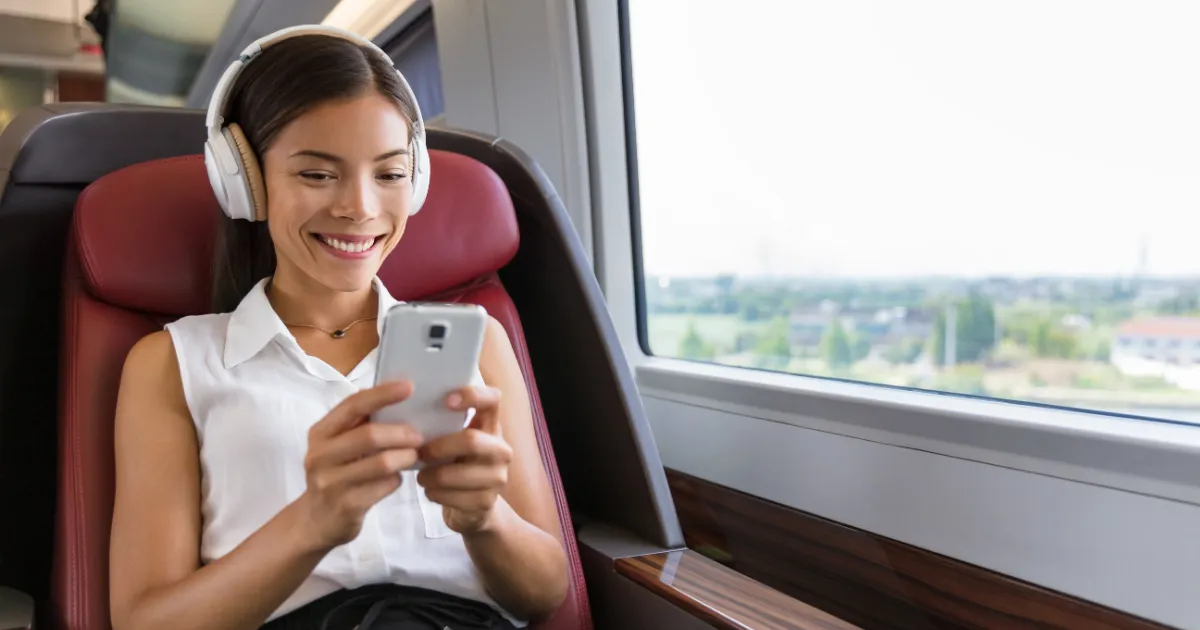
Rail ridership in Europe is at a record high. EU passenger volumes grew +10% between 2023 and 2025 (Moment Onboard Entertainment Platform Trends, 2026). On medium-haul routes, rail competes directly with aviation and increasingly with international operators: since the liberalisation of the European rail market under the EU’s Fourth Railway Package in 2020, carriers such as Trenitalia and Renfe have entered routes previously served exclusively by SNCF Voyageurs. In that context, the onboard digital experience has become a differentiator that operators can no longer treat as secondary.
France’s leading rail operators have not waited for passenger expectations to outpace their offer. TGV INOUI, OUIGO, TGV Lyria, and INTERCITÉS have each built a distinct digital onboard product, reflecting their brand positioning and their passengers’ specific needs. Together, these four deployments reveal how the most forward-looking operators in Europe are treating the onboard portal as a strategic product, not an IT utility.
SNCF Voyageurs is the operator behind all four brands. In 2024, TGV INOUI and OUIGO together carried nearly 130 million passengers in France (SNCF Group Full Year Results, 2024). Across its portfolio, SNCF Voyageurs’ direction is consistent: digitalise the onboard experience, segment content by passenger profile, and make the Wi-Fi portal the central touchpoint of the journey.
TGV INOUI: A Content Experience Built Into the Journey
TGV INOUI is SNCF Voyageurs’ premium high-speed brand, with approximately 360 trains in service. The partnership between TGV INOUI and Moment dates to 2021 and was renewed in 2024.
At the heart of the deployment is content. Moment manages the editorial layer of the TGV INOUI onboard platform, a curated catalog integrated into the portal passengers land on after connecting to Wi-Fi. Business Première passengers access up to 500 titles. Leisure passengers have access to approximately 300 titles. The catalog spans films, series, press, magazines, podcasts, games, manga, and a dedicated kids section.
Two factors define the approach. First, editorial curation is active, not static: updates are monthly and aligned with current events. For the Paris 2024 Olympic Games, the platform offered dedicated content including documentaries, podcasts, and city guides built around the Games in real time. The catalog also includes short films, available across all trains and particularly well-suited to shorter journeys. Second, segmentation is built into the product: Business Première passengers access premium press titles not available in the general catalog.
“We have established a relationship of trust with Moment since 2021, and we are delighted to extend our collaboration,” said Stéphane Rapebach, Marketing and Sales Director of TGV INOUI.
OUIGO: Digital Entertainment as a Commercial Lever
OUIGO operates differently. As SNCF Voyageurs’ low-cost high-speed brand, OUIGO competes on price. Its model is 100% digital from booking to onboard. The onboard digital experience is not an add-on: it is a revenue stream and a satisfaction driver integrated into the product architecture.
The OUIGO and Moment partnership began in 2020, covering 48 high-speed trains. Since launch, OUIGO has carried over 110 million passengers and accounts for one quarter of all high-speed rail traffic in France. Read the full OUIGO case study.
The OUIFI and OUIFUN offers, built by Moment, structure the onboard digital product. OUIFI (€3) provides Wi-Fi access. OUIFUN (€3) adds the entertainment catalog: films, series, press, podcasts, and games, all delivered via a wireless local cloud preloaded on the train. Both together are available for €5. OUIFUN is also included automatically in the OUIGO Plus and OUIGO Full packs. Passengers connect with their own devices; no content depends on live internet connectivity.
The results validate the model. Following deployment, OUIGO recorded an increase in NPS, a higher repurchase rate on equipped routes, particularly Paris-Lyon where OUIGO competes directly with aviation and intercity coaches, and measurable incremental revenue growth.
“Wi-Fi and entertainment are important components of OUIGO France’s growth strategy. This package of services should create additional revenues that will allow us to maintain attractive prices on train tickets,” said Nicolas Launay, Product Manager at OUIGO France.
For a low-cost operator, the logic is clear. Digital entertainment monetises journey time without raising the base ticket price. It differentiates the product on competitive routes. And the e-menu functionality embedded in the portal gives passengers direct access to onboard ordering, extending the commercial scope of the platform beyond pure entertainment.
TGV Lyria: Premium Content Across Two Countries
TGV Lyria is the joint high-speed service connecting France and Switzerland, operated by SNCF Voyageurs (74%) and Swiss Federal Railways CFF (26%). It carries 5.4 million passengers annually across 17 round trips per day, on routes spanning three to four hours: Basel to Paris (~3h), Geneva to Paris (~3h), Zurich to Paris (~4h).
Cross-border travel creates specific requirements. Passenger profiles are mixed: French and Swiss business travelers, leisure passengers, and international visitors with different content expectations. Language segmentation matters. The journey time of three to four hours places Lyria in direct competition with aviation on several corridors. TGV Lyria’s premium positioning requires a digital product that matches what passengers expect from a high-quality cross-border travel experience.
The deployment announced in October 2024 addressed these requirements directly. Moment deployed an optimised Wi-Fi portal with simplified connectivity and improved UX, 100% offline content preloaded on the trains, and exclusive content for Business 1ère passengers secured via a dedicated authentication module including premium press titles. A new dynamic moving map enriched with destination content completes the experience.
“It became clear to us that we needed to rethink our Wi-Fi portal with simpler connectivity, a more ergonomic design, and more French and Swiss content,” said a TGV Lyria spokesperson.
INTERCITÉS: A Platform Built for Every Passenger
INTERCITÉS is SNCF Voyageurs’ long-distance conventional service, connecting Paris to major French cities including overnight routes. It serves a broad passenger mix: longer-distance commuters, families, and travelers for whom overnight rail is a practical alternative to flying. That mix shapes the content requirements.
In 2025, INTERCITÉS ran a formal call for projects to modernise its onboard digital services. Moment was selected. The brief was precise: deliver a branded portal compatible with existing onboard Wi-Fi infrastructure from Icomera and Nomad, with no proprietary hardware required. Read the full INTERCITÉS case study.
Moment deployed a custom portal reflecting INTERCITÉS’ visual identity, with UX designed for diverse audiences including families and younger passengers. The catalog covers 300+ licensed media titles updated monthly, with a developed section for educational content and documentaries, formats that resonate with INTERCITÉS’ family-oriented ridership on longer journeys. Analytics and performance reporting tools give the team ongoing visibility into platform usage.
The decision to select Moment rested on an established track record. INTERCITÉS was not adopting an untested solution. It was extending a model already demonstrated across TGV INOUI, OUIGO, and TGV Lyria, with full interoperability as the primary technical requirement.
Three Principles Across Four Deployments
These four cases differ in positioning, fleet size, and passenger profile. Three structural principles appear across all of them.
Offline-first is a deliberate choice, not a constraint. Every deployment preloads content on onboard servers. No core entertainment experience depends on live internet connectivity. This matters for two reasons beyond content reliability: it reduces bandwidth consumption on the onboard network, preserving connectivity quality for passengers who need it for work, email, or web browsing; and it gives operators direct control over data usage on the train.
Content is segmented by audience, not served generically. TGV INOUI and TGV Lyria both offer differentiated catalogs for Business passengers, with premium press and exclusive titles versus the general offer. INTERCITÉS prioritises educational content and documentaries for a more family-oriented ridership. OUIGO curates for accessibility and variety on a budget-conscious audience. The platform adapts to the operator’s positioning rather than imposing a standard catalog.
The portal is the digital entry point of the journey. Every passenger who connects to onboard Wi-Fi lands there first. Operators use it to structure the full digital experience: content discovery, e-menu access for onboard ordering, moving map, and passenger engagement. Across Moment’s European rail clients, that entry point generated 6.2 million onboard sessions in 2025, with 1.8 million hours of watchtime and a 25% platform penetration rate on journeys of three hours or more (Moment Onboard Entertainment Platform Trends, 2026).
Building the Next Chapter of Your Onboard Digital Experience
Moment equips 500+ trainsets across Europe through its rail onboard experience platform. The question for any operator is not whether to invest in the digital passenger experience. It is how to structure it, brand it, and make it generate measurable value from day one.

Discover our latest news


.webp)

%20(6).png)
%20(1).png)
%20(3).png)
%2520(6).png)
%2520(9).png)
.png)





Ready to redefine your journey with innovative solutions?
Start powering your digital journey with Moment.