Inflight Entertainment Streaming: What Live TV Changes
United launched live TV on Starlink widebodies in June 2026. Here is what it changes for airline content strategy and CSP agreements — and what to act on now.
.webp)
United Airlines launched live TV on Starlink-equipped widebody aircraft in June 2026. Passengers on flight UA14, Newark to London, watched real-time sports broadcasts on seatback screens powered by DIRECTV. This is not a pilot program. It is operational, on up to 150 aircraft. And it changes something specific for airlines rethinking their inflight entertainment streaming strategy: not how IFE works technically, but what you need to negotiate, and when.
Key findings
- Live TV is now operational on commercial aircraft. United Airlines and DIRECTV launched live streaming to seatback screens on Starlink-equipped aircraft in June 2026. It is the first large-scale deployment on a commercial widebody fleet.
- Live rights are not covered by VOD agreements. Inflight live broadcasting requires separate licensing from standard VOD deals: different rights windows, different territorial constraints, different content partners.
- The prerequisite is LEO connectivity, not aircraft type. Any aircraft with a stable low-latency LEO connection is technically eligible. The question for each operator is when that connectivity arrives on their fleet, not whether it applies to them.
- Content licensing decisions need to happen before deployment. Rights windows for live broadcast are negotiated 12 to 24 months ahead. Airlines in active LEO upgrade cycles need to start that conversation now.
What United and DIRECTV actually launched
Live TV in transport is not new. Cruise ships have offered cabin IPTV for decades: live satellite channels delivered to stateroom screens are standard across major lines. What changed in June 2026 is that aviation caught up, and the reason is infrastructure. LEO satellite latency finally makes it technically viable at altitude.
On June 22, 2026, United Airlines operated its first Starlink-equipped widebody transatlantic flight, a Boeing 777 from Newark to London. One day later, the airline announced a partnership with DIRECTV to stream live TV to seatback screens on up to 150 Starlink-enabled aircraft through July 20. The content is delivered via web-enabled OTT applications running on top of the Starlink connectivity pipe, feeding live channels directly to the aircraft's existing seatback system. The technical architecture handles bandwidth management, DVR functionality, and near-live fallback for routes where a sustained real-time feed cannot be guaranteed.
What matters editorially is not which application delivered it. It is that a major carrier demonstrated live TV on seatback screens at scale, on a commercial route, using LEO connectivity. That is the reference point the industry will build from.
Why live TV requires a different content layer
Traditional IFE runs on a library model. Content is licensed, encoded, encrypted, and loaded onto the aircraft server before departure. Delivery is local, from the onboard server to passenger devices over the cabin Wi-Fi, with no dependency on the satellite link during the flight. Rights management is straightforward: fixed catalog, fixed routes, fixed license window.
Live TV breaks each of these assumptions. It requires a stable low-latency connection throughout the flight, which only LEO constellations can currently provide reliably. It requires rights that are territorially specific for live broadcast, different from the inflight VOD rights already negotiated with studios. And it requires content delivery partners with live broadcast agreements in place, not just VOD licensing deals.
The territorial dimension is particularly complex. DIRECTV spent over three years renegotiating the rights to distribute US live channels on international routes before it could offer the service on transatlantic flights. Your existing CSP agreement almost certainly does not cover this. Consumer OTT subscriptions, Netflix, Disney+, Prime, do not grant inflight broadcast rights under standard terms. Live rights are a separate licensing layer, negotiated separately, with different partners.
There is also a bandwidth dependency that does not exist in cached-content models. Live TV requires approximately 3 to 5 Mbps per stream for HD delivery, and unlike cached VOD, the content cannot be pre-loaded to buffer the connection. If the satellite link degrades, the experience degrades immediately. Near-live fallback architectures, where highlights are cached on the aircraft and refreshed within the hour, exist precisely to manage this constraint.
What actually determines eligibility
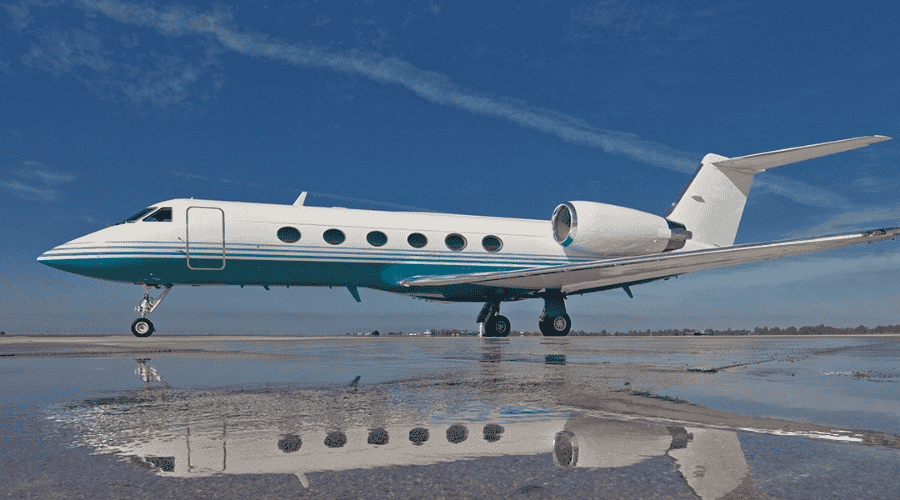
United started with widebody long-haul aircraft because that is where LEO connectivity arrived first at scale. But the type of aircraft is not the determining factor. The prerequisite is the connectivity pipe: any aircraft with a stable LEO connection is technically eligible for live TV delivery, whether it is a narrowbody on a two-hour domestic route or a business jet on a transatlantic crossing.
What determines the timeline for each operator is when LEO connectivity reaches their fleet, and whether their content agreements and CSP infrastructure are ready when it does. United already has Starlink active on more than 400 mainline and regional aircraft, including narrowbodies, with full fleet coverage expected by end of 2027. Approximately 44 airlines have committed to Starlink as of mid-2026. Emirates has surpassed one petabyte of data consumed across 36 Starlink-equipped widebodies.
The practical implication: for airlines currently in LEO upgrade cycles, live TV is closer than it looks. For airlines without a connectivity upgrade in their roadmap, it is not relevant yet. For mixed fleets, the question is how to manage content strategy across connected and non-connected aircraft in parallel.
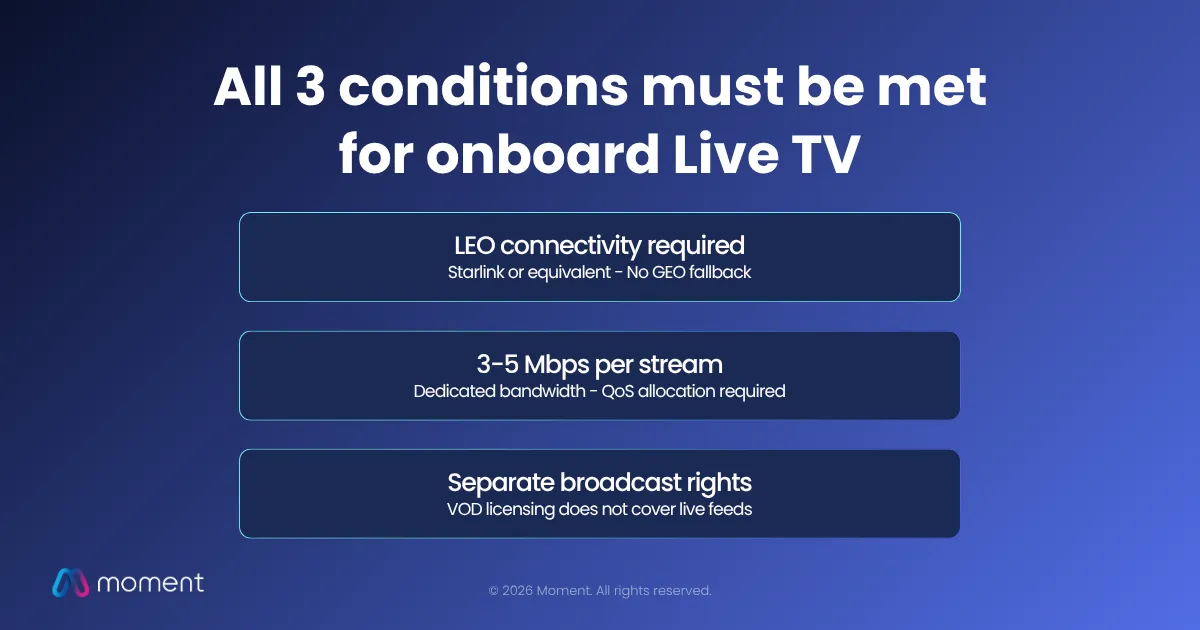
Live TV onboard requires three things working in parallel: a stable LEO connection, specific broadcast licensing, and a content service provider equipped for real-time delivery.
Three questions to bring to your content service provider
Live TV does not replace your VOD strategy. For most airlines, it is an additional layer that requires a separate commercial and technical track. Before that conversation becomes urgent, three questions are worth raising with your content service provider.
Do your current licensing agreements cover live broadcast rights? VOD and live rights are distinct in inflight licensing. Your existing deal likely does not include live. Understanding the gap now avoids a rushed renegotiation at hardware deployment.
What is your capacity for real-time content delivery on connected aircraft? Live distribution requires infrastructure at the CSP level, not just on the aircraft. Near-live fallback, live rights management, and bandwidth-aware delivery are not standard VOD CSP capabilities.
How does live content coexist with your VOD catalog from a passenger UX perspective? Live schedules, event-based programming, and playback controls require different interface logic than on-demand libraries. They need to be integrated into the passenger portal without creating navigation friction.
These are not decisions to make today. They are questions that will determine how quickly you can move once LEO connectivity is in place. The airlines that answer them early will be in a better position when the hardware catches up.
Frequently asked questions
Can airlines offer live TV onboard in 2026?
Yes, on aircraft equipped with low-latency LEO connectivity. United Airlines demonstrated this at scale in June 2026, streaming live TV to seatback screens via DIRECTV on Starlink-equipped aircraft. The service also requires live broadcast rights, which are separate from standard VOD licensing and must be negotiated independently.
Does live TV onboard require a widebody aircraft?
No. The prerequisite is LEO connectivity, not aircraft type. Any aircraft with a stable low-latency satellite connection is technically eligible. United launched on widebodies first because that is where Starlink arrived at scale initially, but the technology applies equally to narrowbodies and business aviation.
Is live TV available on all Starlink-equipped aircraft?
Not automatically. Starlink connectivity is a prerequisite, not a guarantee. The airline must also have live broadcast rights in place with a content partner, and the onboard system must support the delivery application. United's current live TV rollout covers up to 150 aircraft, out of more than 400 already equipped with Starlink.
What is the difference between live TV rights and VOD rights for airlines?
VOD rights cover pre-licensed content loaded onto the aircraft server before departure. Live broadcast rights cover real-time distribution of programming and are negotiated separately, with different territorial restrictions and content partners. Consumer OTT subscriptions do not grant inflight live broadcast rights under standard terms.
What should airlines do now to prepare for live TV onboard?
Airlines in active LEO upgrade cycles should begin conversations with their content service provider about live broadcast licensing, since rights windows are typically negotiated 12 to 24 months before deployment. Airlines without a connectivity upgrade in their roadmap do not need to act immediately, but should understand how the live TV layer will affect their content strategy as LEO coverage expands.
Moment manages content delivery across connected and non-connected fleets, from static catalogs to hybrid models that combine cached VOD, edge-refreshed content, and live delivery layers. See how Moment's content delivery model works.
Discover how Moment equips airlines and aviation operators with wireless IFE and digital passenger experience solutions.

Discover our latest news





%20(6).png)
%20(1).png)
%20(3).png)
%2520(6).png)
%2520(9).png)
.png)








Ready to redefine your journey with innovative solutions?
Start powering your digital journey with Moment.